Today's
EarthStation1.com 15% (Or More!) Off Commemorative Memorial Title:
The Old Time Radio Comedy MegaSet MP3 Collection DVD, Download,
USB
Today, July 3, 2026
July 3: National Eat Beans Day (National
Eat Your Beans Day): -- "I am a bean, very lean. I am not
fat, I'm sure of that." National Eat Beans Day (or National
Eat Your Beans Day) occurs on July 3 each year, and we guarantee
it will be a holiday that will give you a whole new appreciation
for legumes as a food group. And if not, perhaps our fun facts and
riddles will have you full of beans. Try this one on for size - 'I
am a bean, very lean. I am not fat, I'm sure of that. Like all
beans, I'm small and round - but unlike others, I don't grow in
the ground'. Giving away the answer would be too easy, but we'll
give you a hint - this may be a kid's favorite kind of bean. It
may also surprise you to know that beans are not strictly
classified as 'veggies' either since legumes by definition are any
seeds or fruits that grow within pods or the edible pods
themselves, which grow on leguminous plants (i.e. those belonging
to the pea family). This opens up a whole world of beans to us,
which should be exciting, especially for those who grew up being
forced to eat beans as a vegetable. Though the exact date and
reason for National Eat Your Beans Day being made a holiday are
not known, we do know that the history of the bean itself predates
even the invention of the pots used to cook beans. Bean
cultivation dates back as early as 7,000 years ago, making it a
staple that has stood the test of time, and we're not surprised.
With amazing health benefits, legumes are plant-based,
protein-packed powerhouses of nutrition. So this also means that
they're for everyone, no matter the diet or lifestyle choice. It's
very rare to find a person allergic to beans too, though some
legumes can trigger allergic reactions, such as peanuts. Beans are
originally from wild vines which grow in Central and South
America. This is known as the common bean, and since then,
thousands of bean varieties exist today and are cultivated all
over the world. They are one of the most versatile crops and can
be grown almost anywhere. 5,000 years ago the lima bean and other
varieties were a popular favorite among the Incas and Aztecs, and
the popularity of beans is so much so that they are worth a
mention in Homer's "Iliad," where he uses beans as a
metaphor. Ancient Egyptians seem to have also been partial to
beans and lentils, as paintings and physical evidence shows that
bodies were buried with beans, to nourish them on their journey to
the afterlife. By the 1500s, with the advent of trade via ships,
beans began to reach all the corners of the globe and more
varieties began to be cultivated. Though often viewed as a poor
man's food, beans have been an important source of nourishment for
people in dire circumstances; such as the soldiers who fought in
the First and Second World Wars, or the Europeans who were dying
out due to the spread of the plague in Europe, during the Middle
Ages. Who would have thought beans could be such lifesavers. On
Sale Till Midnight PT!
https://store.earthstation1.com/old-time-radio-comedy-mp3-dvd-megaset-2-dis32.html
Today's
EarthStation1.com 15% (Or More!) Off Commemorative Memorial Title:
In Heaven There Is No Beer Polka Culture USA MP4 Video Download
DVD
Today, July 3, 2026
July 3: National Independent Beer Run
Day: -- Show your Independence Day spirit and support the small
craft brewers! Today beer lovers across the country call for
Americans to buy craft-made beer ahead of Independence Day. Many
independent beer lovers will be raising a glass for their annual
celebration this year. The event is intended to promote
independence from imported beers and from significant beer
business practices that threaten autonomous craft brewers. The
American craft beer industry has seen unprecedented support this
year as the total number of breweries in the U.S. has reached a
high. The first American lager was brewed in 1840 by John Wagner,
a German immigrant who brought a brewing yeast with him to
Philadelphia, marking the beginning of the modern U.S. beer
industry. The country's first large brewery, which opened in 1857,
produced 1,000 barrels; today, Budweiser alone makes more than 100
million barrels per year. Until Prohibition, most American beers
were brewed by small companies in their local communities. When
Prohibition was repealed in 1933, beer companies also had to be at
least partially owned by Americans to sell beer. Because only
large companies had the resources to comply with the new legal
requirements for breweries, smaller brewers were acquired or went
out of business, and within five years of Prohibition's repeal,
nearly all beer production was controlled by just 50 companies.
After Prohibition ended, beer lovers across America rejoiced at
their newfound freedom. It didn't take long for Americans to
rediscover their love of beer or for those who had never given it
up, to start brewing. Craft breweries began popping up all over
the place, and by 1980 there were 42 independent breweries in the
United States. National Independent Beer Run Day, celebrated on
July 3, is an unofficial holiday that encourages beer lovers to
support local breweries. The day was declared on June 26, 2019, by
Brewers Association, the organization behind American Craft Beer
Week and Savor, an American Craft Beer and Food Experience.
National Independent Beer Run Day calls on beer lovers to seek out
self-governed craft beers for their July 4 celebrations. On Sale
Till Midnight PT!
https://store.earthstation1.com/in-heaven-there-is-no-beer-polka-culture-usa-mp4-video-download-dv4.html
Today's
EarthStation1.com 15% (Or More!) Off Commemorative Memorial Title:
Classic Juvenile Delinquency Films Collection MP4 Video Download
DVD
Today, July 3, 2026
July 3: Disobedience Day: -- In the words
of American naturalist, essayist, poet, and philosopher Henry
David Thoreau, "Disobedience is the true foundation of
liberty. The obedient must be slaves." - curious to know
more? Well then -- if you're not one to play by the rules, then
today is a day you just can't miss out on! If we were being fancy
and literary, we'd probably use the term 'carnivalesque' - but
whichever way you slice it, it's about letting loose and being a
bit subversive in your own right. Subversion has been popular
throughout history, in fact, the very wheels of history have often
turned based on subversive events of every kind. Be it through
bloody revolutions, 'flower power,' listening to rebel rock &
roll, or just standing up for the underdog; everyone can find it
in themselves to break free of the constraints society has
imposed, even if it's just a little bit. Essentially, at its core,
Disobedience Day is about non-violent protests of issues, laws, or
causes which are perceived to be unjust, so we're in no way
encouraging kids to disobey their parents, or for anyone to use
this as an excuse to rail against "the Man." The true
spirit of this day is in trying something different, standing up
for yourself or someone else, especially if you're burdened by
rules or structures which have been misused or made life just too
mundane. Though the exact origins of Disobedience Day and any
record of its first observance are not to be found, the existence
of several days pertaining to civil or social disobedience
suggests that this day intends to promote education on civil
disobedience. We have good reason to believe that this day has
been founded to encourage people to live a little by breaking free
of some of the more oppressive rules or structures they may be
stuck within. It can also be a great day to find out more about
what the core tenets of Civil Disobedience are. We have only to
flip through the pages of our history textbooks to see how
disobedience has helped change the world when done in the right
way and with a true spirit of justice. From the Civil Rights
Movement in America in the 1950s-60s to the freedom struggle in
India against the British Empire (1930s-40s) to the Suffragette
movement in Britain in the 1920s - non-violent fights against
varying forms of oppression are peppered across the world, both
big and small. If you think about it, obedience to someone else
has been ingrained in every human being since birth, as we are
told to first obey our parents, then teachers, bosses, and other
social authority figures and/or institutions. And though no man is
an island, no one is a mere robot either - it's also ingrained in
our very souls to seek freedom and meaning of our own. So why not
use Disobedience Day to your own advantage, by making it your own
in whatever uniquely 'you' way you want to. The key is to be
respectful and mindful of the fact that everyone can make this day
their own, so no encroaching on that fundamental right! On Sale
Till Midnight PT!
https://store.earthstation1.com/classic-juvenile-delinquency-films-collection-mp4-video-download-dv4.html
Today's
EarthStation1.com 15% (Or More!) Off Commemorative Memorial Title:
The Uncle Dave Macon Program DVD, MP4 Video Download, USB Flash
Drive
Today, July 3, 2026
July 3: American Redneck Day: -- A day to
find out about redneck culture and get into the swing of things on
this fun day. The festivities are loudest in the south of America,
where people are more commonly characterized as rednecks. American
Redneck Day is a day for people who have been termed rednecks to
celebrate their identity and reclaim the word from its derogatory
roots. 'Redneck' is a term applied to white American people who
are perceived to be unsophisticated or crass, particularly those
from rural backgrounds and lifestyles. Over time, the word has
become part of the American lexicon as offensive slang and is used
to include racist and boorish white Americans. However, 'redneck'
can also be viewed as a lifestyle. American Redneck Day is
celebrated on July 3 every year. The day is observed across the
country, particularly in the southern United States of America,
where people are more likely to be categorized as rednecks. The
epithet 'redneck' is used to characterize white Americans from
rural backgrounds perceived as crass and unpolished. Originally
used to describe farmers and coal miners, 'redneck' is a word
applied in myriad ways. While it has been used in denigratory
ways, southern farmers proudly referred to themselves as rednecks
even in the early days when the word was supposed to mean a poor
and uneducated white farmer. While the term has always been
derogatory, it has become increasingly offensive over the years.
Now referring to someone as a redneck is usually a way of labeling
a white American racist, boorish, unwilling to adapt, and
resistant to progress. In media and popular culture, rednecks are
stereotyped as poor, dirty, uneducated, unsophisticated, and
racist Southern men. Over time, the term became increasingly
politicized as people began to call on the American rednecks to
wear their title proudly, mobilize for various causes, and protect
their interests. Many southerners adopt the term as a
self-identifier and are proud of being American Rednecks. Despite
the negative representation, the question of rednecks in popular
culture changed the perception of the word, making rednecks
supercool. The increasing popularity of country music has also
played a big hand in changing the understanding of the term. The
significance of the word becomes more complex by the increased
mobility of people from the south. With comedians, actors, and
trendy musicians adopting their redneck heritage and wearing their
status proudly, the essence of the term has expanded into a symbol
of collective identity. On Sale Till Midnight PT!
https://store.earthstation1.com/the-uncle-dave-macon-program-dvd.html
Today's
EarthStation1.com 15% (Or More!) Off Commemorative Memorial Title:
The Wisdom Of The Dream: Carl Jung A Life Of Dreams DVD, Download,
USB
Today, July 3, 2026
July 3: Start The Conversation Day: -- A
day to raise awareness to check up on people's mental health.
Mental illness may be socially isolating, so it's crucial to check
in on our friends and family regularly to show them that we care
about their overall well-being. The day encourages individuals to
communicate with anybody without reluctance or fear. The
conversation is the sole means for two or more individuals to
share information. It is critical to have effective communication
skills since they play an important part in socializing with
others. Only talking allow you to express yourself genuinely. To
keep a discussion entertaining, effective listening, turn-taking,
praising, being confident, keeping things simple, and various
other abilities are required. To begin, maintain, or end a
relationship, you must master the skill of speaking. The origin,
history, and inventor of Start the Conversation Day remain
unknown. Although the author's intention for the day is obvious,
the creator wants the readers to engage in fresh dialogues with
individuals they already know just to check in on them and their
mental health. The issues and traumas that disadvantaged,
oppressed, and disenfranchised individuals encounter are unique
and must be treated accordingly. To overcome mental health
disorders and incorrect diagnoses, it is critical to have skilled
and compassionate mental health providers. Try to check on the
mental health of new individuals you just met is also good, by
discussing fresh issues will always provide communicators with new
information and experience. We must engage in fresh interactions
with others around us to let them know that we are concerned about
their overall health. The innovator intends to enhance mental
health awareness and minority mental health awareness during
National Minority Mental Health Awareness Month by introducing
Start the Conversation Day. In July, Mental Health America
organizes a national campaign called National Minority Mental
Health Month. It aspires to raise awareness of the many mental
health experiences that BIPOC (Black, Indigenous, and people of
color) populations face. The month also considers injustices,
including structural and historical obstacles that have a
detrimental influence on a person's mental health. Start the
Conversation Day is an opportunity to check in on a loved one's
mental health and show that we care about their well-being. This
day is significant in ensuring that people may live in peace with
one another, regardless of how unlike each other they are or how
strongly they disagree. New talks are often unpleasant and full of
assumptions on both sides. On Sale Till Midnight PT!
https://store.earthstation1.com/the-wisdom-of-the-dream-carl-jung--a-life-of-dreams-dvd.html
Today's
EarthStation1.com 15% (Or More!) Off Commemorative Memorial Title:
Pickett's Charge: The Turning Point Of The Civil War MP4 Download
DVD
Today, July 3, 2026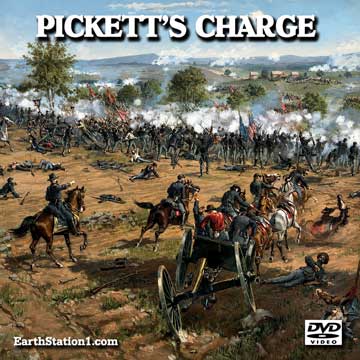
July 3, 1863: The American Civil War (The
Civil War, The War Between The States): The Eastern Theater Of The
American Civil War: The Gettysburg Campaign: The Battle Of
Gettysburg: Pickett's Charge (The Pickett-Pettigrew-Trimble
Charge): -- The final day of the Battle Of Gettysburg culminates
with Pickett's Charge, an infantry assault ordered by Confederate
Gen. Robert E. Lee against Maj. Gen. George G. Meade's Union
positions on July 3, 1863, the last day of the Battle Of
Gettysburg in the state of Pennsylvania during the American Civil
War. Its futility was predicted by the charge's commander, Lt.
Gen. James Longstreet, and it was arguably an avoidable mistake
from which the Southern war effort never fully recovered
militarily or psychologically. The farthest point reached by the
attack has been referred to as the high-water mark of the
Confederacy. The charge is named after Maj. Gen. George Pickett,
one of three Confederate generals who led the assault under
Longstreet. As soldiers straggled back to the Confederate lines
along Seminary Ridge, Lee feared a Union counteroffensive and
tried to rally his center, telling returning soldiers that the
failure was "all my fault." Pickett was inconsolable.
When Lee told Pickett to rally his division for the defense,
Pickett allegedly replied, "General Lee, I have no
division.". On Sale Till Midnight PT!
https://store.earthstation1.com/picketts-charge-the-turning-point-of-the-civil-war-mp4-download-dvd.html
Today's
EarthStation1.com 15% (Or More!) Off Commemorative Memorial Title:
Long Shadows: Civil War Legacy DVD, Video Download, USB Flash
Drive
Today, July 3, 2026
July 3, 1913: The American Civil War (The
Civil War, The War Between The States): The Eastern Theater Of The
American Civil War: The Gettysburg Campaign: The Battle Of
Gettysburg: The Great Reunion (The Great Reunion Of 1913, The 1913
Gettysburg Reunion): -- Confederate veterans at the Great Reunion
Of 1913 reenact Pickett's Charge; upon reaching the high-water
mark of the Confederacy they are met by the outstretched hands of
friendship from Union survivors. On Sale Till Midnight PT!
https://store.earthstation1.com/long-shadows-dvd-legacy-of-the-american-civil-war.html
Today's
EarthStation1.com 15% (Or More!) Off Commemorative Memorial Title:
The Battle Of Gettysburg Civilians DVD MP4 Download USB Flash
Drive
Today, July 3, 2026
July 3, 1938: The American Civil War (The
Civil War, The War Between The States): The Eastern Theater Of The
American Civil War: The Gettysburg Campaign: The Battle Of
Gettysburg: The Eternal Light Peace Memorial: -- United States
President Franklin D. Roosevelt dedicates the Eternal Light Peace
Memorial and lights the eternal flame at Gettysburg Battlefield.
The natural gas flame in a one-ton bronze urn is atop a tower on a
stone pedestrian terrace with views from the terraced hill summit
over about 400 sq mi (1,000 km2), and the flame is visible from 20
mi (32 km) away. On Sale Till Midnight PT!
https://store.earthstation1.com/the-battle-of-gettysburg-civilians-dvd-mp4-download-usb-flash-driv4.html
Today's
EarthStation1.com 15% (Or More!) Off Commemorative Memorial Title:
A Duke Named Ellington TV Series Duke Ellington DVD Download USB
Drive
Today, July 3, 2026
July 3, 1775: Spirituality: Fraternal
Organizations: Freemasonry (Masonry): Freemasonry In The United
States: African-American Fraternal Orders: Prince Hall
Freemasonry: The Founding Of African Lodge No. 1: -- Prince Hall
founds African Lodge No. 1, the first Black Lodge of Free Masons
in the United States, with Prince Hall himself as Worshipful
Master. Official acknowledgment of the legitimacy of African Lodge
No. 1 was made almost immediately by John Rowe of Boston, a
Provincial Grand Master For North America holding authority from
the premier Grand Lodge Of Freemasons, the Grand Lodge Of England.
He, like the Master Of Lodge No. 441 who initiated them, British
Army Sergeant Sergeant John Batt, issued a permit authorizing
African Lodge No. 1 to appear publicly in procession as a Masonic
body for the purpose of celebrating the Feast of St. John and to
bury its dead. Black Freemasonry began when Prince Hall and
fourteen other free black men were initiated by members of Lodge
No. 441, Irish Constitution, attached to one of General Gage's
regiments -- the 38th Regiment of Foot, British Army garrisoned at
Castle Williams Island (now Fort Independence), Boston Harbor on
March 6, 1775. The Master Of Lodge No. 441 was Sergeant John Batt.
Along with Prince Hall, the others were Peter Freeman, Benjamin
Tiber, Duff Bufform, Thomas Sanderson, Prince Payden, Cato Speain,
Boston Smith, Peter Best, John Canton, Prince Rees, Cyrus Johnbus,
Bueston Slinger, Fortin Howard and Richard Tilley. There is some
variance in the spelling of the names, depending on the source. By
the end of the American Revolution, in 1781, American
predominately white Lodges had begun declaring independence from
the English Grand Lodge. They were not interested in granting a
charter to Prince Hall or African Lodge. Although the members of
African Lodge No. 1 were free men, black men were automatically
assumed by the Masonic colonists to have "obligations"
to masters. Thus, predominately white Lodges in America were not
interested in reciprocal recognition with African Lodge, nor were
they interested in bringing them under their jurisdiction. On
March 2, 1784 and June 30, 1784, African Lodge No. 1 petitioned
the Grand Lodge of England for a warrant (or charter) to organize
a regular Masonic Lodge, with all the rights and privileges
thereunto prescribed. Prince Hall petitioned the Grand Lodge of
England through Worshipful Master William Moody of Brotherly Love
Lodge No. 55 (London, England) for a warrant or charter. The
charter was prepared and issued on September 29, 1784, although it
would be three years before African Lodge actually received it.
The Grand Lodge of England assigned number 459 to African Lodge
No. 1. Captain James Scott delivered the charter on April 29,
1787. Captain James Scott was Master of the Neptune, and also
worked with John Hancock, who was one of the signers of the
Declaration of Independence. By virtue of the authority of this
charter, African Lodge No. 459 was organized one week later and
began work as a regular Masonic Body on May 6, 1787. The warrant
to African Lodge No. 459 of Boston is the most significant and
highly prized document known to the Prince Hall Masonic
Fraternity. It is also the only known charter in existence in
America issued by the Grand Lodge of England. Subsequent to
establishing Lodge No. 459 of Boston, Prince Hall established
African Lodge 459, F. & A. M. of North America at Philadelphia
in 1797 and also a lodge at Providence, Rhode Island. Shortly
thereafter he chartered Union Lodge No. 3 and Laurel Lodge No. 4
of Pennsylvania. These Lodges remained subordinate to the Mother
Lodge in Massachusetts until December 27, 1815, at which time the
three Pennsylvania Lodges met in general assembly and organized
African Grand Lodge of North America with jurisdiction over the
State of Pennsylvania and the South including the District of
Columbia. Thus we have the succession of events leading up to the
petitioning of the subject Grand Lodge in Washington, D.C., by the
founders of Social Lodge. On Sale Till Midnight PT!
https://store.earthstation1.com/a-duke-named-ellington-dvd-complete-2-part-tv-serie2.html
Today's
EarthStation1.com 15% (Or More!) Off Commemorative Memorial Title:
Meet George Washington: The Man Behind Myth + Bonus MP4 Download
DVD
Today, July 3, 2026
July 3, 1754: The Anglo-French Wars
(1109-1815): The Second Hundred Years' War (1689-1815): The Sixty
Years' War (French: Guerre De Soixante Ans) (1754-1815): The
French And Indian War: The Battle Of Fort Necessity (The Battle Of
The Great Meadows): -- 22-year-old Lieutenant Colonel George
Washington surrenders Fort Necessity, built by Washington on an
alpine meadow west of the summit of a pass through the Laurel
Highlands of the Allegheny Mountains, when Canadian forces from
Fort Duquesne compelled his surrender; the engagement, along with
the May 28 skirmish known as the Battle Of Jumonville Glen, was
the first military combat experience for George Washington, and
began the French And Indian War, which later spiraled into the
global conflict known as The Seven Years' War.. The Battle Of Fort
Necessity took place on July 3, 1754, in present-day Farmington in
Fayette County, Pennsylvania. The terms of Washington's surrender
included a statement (written in French, a language Washington did
not read) falsely asserting that Joseph Coulon de Jumonville,
defeated and killed at The Battle Of Jumonville Glen by George
Washington's forces, was assassinated, not a military causualty.
This document and others were used by the French and Canadiens to
level accusations that Washington had ordered Jumonville's
slaying. On Sale Till Midnight PT!
https://store.earthstation1.com/meet-george-washington-the-man-behind-myth-dvd-mp4-us4.html
Today's
EarthStation1.com 15% (Or More!) Off Commemorative Memorial Title:
American Revolutionary War Documentaries DVD, Download, USB Drive
Today, July 3, 2026
July 3, 1775 : The Age Of Enlightenment
(The Enlightenment, The Age Of Reason): The Age Of Revolution: The
Atlantic Revolutions: The American Enlightenment: The American
Revolution: The American Revolutionary War: -- George Washington
takes command of the Continental Army at Cambridge, Massachusetts.
The Continental Army was formed by the Second Continental Congress
after the outbreak of the American Revolutionary War by the
ex-British colonies that became the United States of America.
Established by a resolution of the Congress on June 14, 1775, it
was created to coordinate the military efforts of the Thirteen
Colonies in their revolt against the rule of Great Britain. The
Continental Army was supplemented by local militias and volunteer
troops that remained under control of the individual states or
were otherwise independent. General George Washington was the
commander-in-chief of the army throughout the war. Most of the
Continental Army was disbanded in 1783 after the Treaty Of Paris
formally ended the war. The 1st and 2nd Regiments went on to form
the nucleus of the Legion of the United States in 1792 under
General Anthony Wayne. This became the foundation of the United
States Army in 1796. On Sale Till Midnight PT!
https://store.earthstation1.com/american-revolutionary-war-dvd-documentaries.html
Today's
EarthStation1.com 15% (Or More!) Off Commemorative Memorial Title:
Spanish-American War & Cuban War Of Independence DVD,
Download, USB
Today, July 3, 2026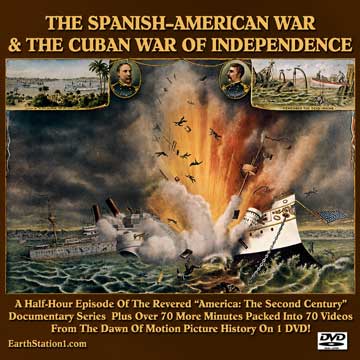
July 3, 1898: The Decolonization Of The
Americas: The Cuban War Of Independence (The Necessary War): The
Spanish-American War: The Battle Of Santiago De Cuba: -- In one of
the most significant naval battles in US maritime history, a
Spanish naval squadron of four armored cruisers and two
destroyers, led by Pascual Cervera y Topete, steams out of the
harbor of Santiago de Cuba to engage with an American fleet
consisting of four battleships and two armored cruisers, led by
William T. Sampson and Winfield Scott Schley. The Spanish, totally
unprepared and outgunned, made a desperate attempt to reach the
open sea with the American battleships and cruisers in hot
pursuit. The entire Spanish fleet was sunk, with no American ships
lost and only two Americans killed or wounded. The Americans
pulled a total of 1,889 Spanish sailors from the water, among them
Cervera. The captured Spaniards were treated with respect and care
by the Americans, and Cervera gained respect from the American
officers for his dignified conduct during and after the battle.
This crushing defeat sealed American victory in the
Spanish-American War and achieved nominal independence for Cuba
from Spanish rule. The battle marked the culmination of the Cuban
Wars for Independence that had been waged by Cuban revolutionaries
against Spanish imperial power for several decades. Tensions
between Spain and the United States worsened over the Spanish
conduct during The Cuban War Of Independence, with many Americans
being agitated by largely exaggerated reports of Spanish
atrocities against the Cubans. In January 1898, fearing the fate
of American interests in Cuba from the war, the cruiser USS Maine
was dispatched to protect them. Less than a month later, the
cruiser exploded while lying at anchor in Havana harbor, killing
266 sailors and inflaming American opinion with Spain being
portrayed as the culprit in the American media at the time,
regardless of the actual source of the explosion. Two months
later, war was declared. The Americans realized that defeating the
significant Spanish naval squadron stationed in Cuba was vital to
ensuring victory in the war. Accordingly, an American squadron
consisting of six warships were dispatched to ensure success,
commanded by both Sampson and Schley, each admiral having his own
approach to naval warfare. Although the battle ensured the
American campaign in Cuba would end in a success, tensions soon
arose between Sampson and Schley, with various parties in the US
Navy and the American public debating over which admiral had made
the greater contribution to victory, and the dispute reached the
desk of President Theodore Roosevelt. The American victory bred
controversy in the ranks of the naval officer corps over the
question of the commanding officer who deserved credit for the
victory. Should it be Sampson, who was in operational command of
the fleet, but absent when Cervera's force engaged the Americans,
or Schley, who remained in tactical command during Sampson's
absence and who saw the fight to a successful close from the
bridge of Brooklyn? The controversy between the two officers began
almost immediately after the conclusion of the battle. The
controversy quickly became a public spectacle inflamed by
journalistic sensationalism, popular interest in the recent war,
and in the war's celebration of military heroism. A court of
inquiry opened on September 12, 1901 at the Washington Navy Yard
to investigate 24 charges against Schley from his search for
Cervera off Cienfuegos to the conclusion of the Battle of Santiago
de Cuba. Contrary to public opinion, the court concluded after 40
days of deliberations closely followed by the public and the press
that Schley did not "project the right image of a naval
officer" because of his failure to act "decisively".
Disappointed with the court's conclusions, Schley appealed his
case to President Theodore Roosevelt. The president called for an
end to all public disputes. Tensions died down temporarily, but
arose after the publication of Long's personal memoir in which the
former secretary of the navy credited Sampson fully and believed
that Schley contributed little to the battle's outcome. Sampson
died in 1902 and Schley in 1911, but the controversy left an
internecine struggle within the Navy that in some ways tarnished
its image after what had otherwise seemed a glorious naval
victory. On Sale Till Midnight PT!
https://store.earthstation1.com/spanishamerican-war-films-dvd.html
Today's
EarthStation1.com 15% (Or More!) Off Commemorative Memorial Title:
Great Days Of The Century: World War II TV Series DVD, Download,
USB
Today, July 3, 2026
July 3, 1940: The European Civil War:
World War II: The Second European War (The European Theater Of
World War II): The Mediterranean And Middle East Theater Of World
War II: The Battle Of The Mediterranean: Operation Catapult: The
Attack On Mers-el-Kebir (The Battle of Mers-El-Kebir): -- To stop
ships from falling into German hands the French fleet of the
Atlantic, based at Mers El Kebir on the coast of French Algeria,
is bombarded by the British fleet, coming from Gibraltar, causing
the loss of three battleships: Dunkerque, Provence and French
battleship Bretagne, and the lives of 1,297 French servicemen, for
a British loss of five aircraft shot down and two crewmen killed.
The Attack on Mers-el-Kebir, also known as the Battle of
Mers-el-Kebir, was part of Operation Catapult. The attack by
air-and-sea was conducted by the Royal Navy after France had
signed armistices with Germany and Italy that came into effect on
25 June. Of particular significance to the British were the seven
battleships of the Bretagne, Dunkerque and Richelieu classes, the
second largest force of capital ships in Europe after the Royal
Navy. The British War Cabinet feared already that France would
hand the ships to the Kriegsmarine, giving the Axis assistance in
the Battle of the Atlantic or Battle of the Mediterranean. Admiral
Francois Darlan, commander of the French Navy, promised the
British that the fleet would remain under French control but
Winston Churchill and the War Cabinet judged that the fleet was
too powerful to risk an Axis take-over. After the attack at
Mers-el-Kebir and the Battle of Dakar, French aircraft raided
Gibraltar in retaliation and the Vichy government severed
diplomatic relations with the United Kingdom. The attack created
much rancour between France and the UK but also demonstrated to
the world that the UK intended to fight on. The attack is
controversial and the motives of the British are debated. In 1979,
P. M. H. Bell wrote that "The times were desperate; invasion
seemed imminent; and the British government simply could not
afford to risk the Germans seizing control of the French fleet...
The predominant British motive was thus dire necessity and
self-preservation". The French thought they were acting
honourably in terms of their armistice with Nazi Germany and were
convinced they would never turn over their fleet to Germany. Vichy
France was created on 10 July 1940, one week after the attack and
was seen by the British as a puppet state of the Nazi regime.
French grievances festered for years over what they considered a
betrayal by their ally. On 27 November 1942, the scuttling of the
French fleet in Toulon foiled Operation Anton, a German attempt to
capture the rest of the French fleet after the Allied invasion of
Morocco and French Algeria in Operation Torch. On Sale Till
Midnight PT!
https://store.earthstation1.com/great-days-of-the-century-world-war-ii-all-3-episodes-dual-layer-dv3.html
Today's
EarthStation1.com 15% (Or More!) Off Commemorative Memorial Title:
The Western Tradition TV Series DVD, MP4 Video Download, USB Drive
Today, July 3, 2026
July 3, 987: The French Monarchy (The
Monarchy Of The Kingdom Of France): Royal Accessions: Coronations:
-- Hugh Capet, founder of and first king from the House Of Capet
that would rule France until the French Revolution in 1792, is
elected and crowned Rex Francorum (French: King Of The Franks) at
Noyon in Picardy on July 3, 987, by the Prelate Of Reims, a
convention of the greatest lords of France presided over by
Archbishop Adalberon. The Archbishop promoted the candidacy of
Hugh Capet with the words "Crown the Duke. He is most
illustrious by his exploits, his nobility, his forces. The throne
is not acquired by hereditary right; no one should be raised to it
unless distinguished not only for nobility of birth, but for the
goodness of his soul." Hugh Capet, King of France from 987 to
996, the first of the Capetian dynasty, was born Hugues Capet c.
939 in Paris, West Francia. The son of the powerful duke Hugh The
Great and his wife Hedwige Of Saxony, he was elected as the
successor of the last Carolingian king, Louis V. Hugh was
descended from Charlemagne's son Pepin Of Italy through his mother
and paternal grandmother, respectively, and was also a nephew of
the East Frankish King Otto The Great. The dynasty he founded
ruled France for nearly three and a half centuries from 987 to
1328 in the senior line, and until 1848 via cadet branches, the
male-line descendants of a monarch's or patriarch's younger sons
(cadets), with an interruption from 1792 to 1814. Hugh Capet died
on October 24, 996 aged 56-57 in Paris, France. He was interred in
the Saint Denis Basilica. His son Robert, who was crowned Junior
King in 987, continued to reign as Robert II of France, the second
of the Capetian dynasty. Most historians regard the beginnings of
modern France as having initiated with the coronation of Hugh
Capet. This is because, as Count of Paris, he made the city his
power centre. The monarch began a long process of exerting control
of the rest of the country from there. He is regarded as the
founder of the Capetian dynasty. The direct Capetians, or the
House Of Capet, ruled France from 987 to 1328; thereafter, the
Kingdom was ruled by cadet branches of the dynasty. All French
kings through Louis Philippe, and all royals since then, have
belonged to the dynasty. Furthermore, cadet branches of the House
continue to reign in Spain and Luxembourg. All monarchs of the
Kingdom of France from Hugh Capet to Philip II of France were
titled 'King of the Franks'. Documents during Philip II's reign
began using the title 'King of France' as dawn of the intimate
unification of medieval French population even though Latin was
the main language. On Sale Till Midnight PT!
https://store.earthstation1.com/the-western-tradition-dvd-set-all-52-shows-13-d5213.html
Today's
EarthStation1.com 15% (Or More!) Off Commemorative Memorial Title:
Turning Points Of Second World War Midway El Alamein Stalingrad
DVD MP4 USB
Today, July 3, 2026
July 3, 1886: #BOTD: #HBD! Raymond A.
Spruance, American admiral and diplomat, United States Ambassador
to the Philippines (d. December 13, 1969) is #born Raymond Ames
Spruance in Baltimore, Maryland. Spruance commanded U.S. naval
forces during two of the most significant naval battles that took
place in the Pacific theater, the Battle of Midway and the Battle
of the Philippine Sea. The Battle of Midway was the first major
victory for the United States over Japan and is seen by many as
the turning point of the Pacific war. The Battle of the Philippine
Sea was also a significant victory for the US. The Navy's official
historian said of the Battle of Midway "...Spruance's
performance was superb...(he) emerged from this battle one of the
greatest admirals in American naval history". After the war,
Spruance was appointed President of the Naval War College, and
later served as American ambassador to the Philippines. Spruance
was nicknamed "electric brain" for his calmness even in
moments of supreme crisis, a reputation enhanced by his successful
tactics at Midway. Raymond A. Spruance died of Arteriosclerosis in
Pebble Beach, California, aged_83. He was buried with full
military honors at Golden Gate National Cemetery near San
Francisco. His wife, Margaret Dean (1888-1985), is buried
alongside him, as are Fleet Admiral Chester Nimitz, his longtime
friend Admiral Richmond K. Turner, and Admiral Charles A.
Lockwood, an arrangement made by all of them while living. On Sale
Till Midnight PT!
https://store.earthstation1.com/turning-points-of-2nd-world-war-midway-el-alamein-stalingrad-dv2.html
Today's
EarthStation1.com 15% (Or More!) Off Commemorative Memorial Title:
The Unknown War: The Great Patriotic War Series WWII USSR DVD MP4
USB
Today, July 3, 2026
July 3, 1944: The European Civil War:
World War II: The Second European War (The European Theater Of
World War II): The Eastern Front Of World War II: The Great
Patriotic War (The German-Soviet War): Operation Bagration
(Russian: Operatsiya Bagration) (The 1944 Soviet Byelorussian
Strategic Offensive Operation [Russian: Belorusskaya
Nastupatelnaya Operatsiya "Bagration"]): The Minsk
Offensive (Russian: Minskaya Nastupatel'naya Operatsiya): -- Minsk
is liberated from Nazi control by Soviet troops after encircling
the German Fourth Army in the city of Minsk. Hitler ordered the
Fourth Army to hold fast, declaring the city to be fortified place
("fester platz") and defended even if encircled. The
Soviet 5th Guards Tank Army attacked from the north-east, while
the 2nd Guards Tank Corps moved in from the east, and the 65th
Army advanced from the south. About 100,000 Axis soldiers from the
Fourth and Ninth Armies were encircled, of whom some 40,000 were
killed and most of the rest captured. The result was a complete
victory for the Red Army, the liberation of Minsk, and the rapid
destruction of much of the German Army Group Centre. After Germany
invaded the Soviet Union on 22 June 1941, as part of Operation
Barbarossa, Minsk immediately came under attack. The city was
bombed on the first day of the invasion and came under Wehrmacht
control four days later. However, some factories, museums and tens
of thousands of civilians had been evacuated to the east. The
Germans designated Minsk the administrative centre of
Reichskomissariat Ostland. Communists and sympathisers were killed
or imprisoned, both locally and after being transported to
Germany. Homes were requisitioned to house invading German forces.
Thousands starved as food was seized by the German Army and paid
work was scarce. Minsk was the site of one of the largest Nazi-run
ghettos in the Second World War, temporarily housing over 100,000
Jews (see Minsk Ghetto). Some anti-Soviet residents of Minsk, who
hoped that Belarus could regain independence, did support the
Germans, especially at the beginning of the occupation, but by
1942, Minsk had become a major centre of the Soviet partisan
resistance movement against the invasion, in what is known as the
German-Soviet War. For this role, Minsk was awarded the title Hero
City in 1974. The Minsk Offensive was part of the second phase of
the Belorussian Strategic Offensive of the Red Army in summer
1944, commonly known as Operation Bagration. Operation Bagration
(Russian: Operatsiya Bagration) was the codename for the Soviet
1944 Belorussian Strategic Offensive Operation, (Russian:
Belorusskaya Nastupatelnaya Operatsiya Bagration) a military
campaign fought between 22 June and 19 August 1944 in Soviet
Byelorussia in the Eastern Front of World War II. The Soviet Union
achieved a major victory by destroying the German Army Group
Centre and completely rupturing the German front line. On 23 June
1944, the Red Army attacked Army Group Centre in Byelorussia, with
the objective of encircling and destroying its main component
armies. By 28 June, the German Fourth Army had been destroyed,
along with most of the Third Panzer and Ninth Armies. The Red Army
exploited the collapse of the German front line to encircle German
formations in the vicinity of Minsk and destroy them, with Minsk
liberated on 4 July. With the end of effective German resistance
in Byelorussia, the Soviet offensive continued further to
Lithuania, Poland and Romania over the course of July and August.
The Red Army successfully used the Soviet deep battle and
Maskirovka strategies for the first time to full extent, albeit
with continuing heavy losses. Operation Bagration diverted German
mobile reserves to the central sectors, removing them from the
Lublin-Brest and Lvov-Sandomierz areas, enabling the Soviets to
undertake the Lvov-Sandomierz Offensive and Lublin-Brest
Offensive. This allowed the Red Army to reach the Vistula river
and Warsaw, which in turn put Soviet forces within striking
distance of Berlin, conforming to the concept of Soviet deep
operations - striking deep into the enemy's strategic depths. On
Sale Till Midnight PT!
https://store.earthstation1.com/the-unknown-war-complete-tv-series-soviet-union-wwii-10-dvd-s10.html
Today's
EarthStation1.com 15% (Or More!) Off Commemorative Memorial Title:
U.S. Missiles Of The Cold War + 2 Bonus Titles MP4 Video Download
DVD
Today, July 3, 2026
July 3, 1988: Aviation: The History Of
Aviation: The History Of Military Aviation: Aviation Incidents And
Accidents: The Cold War: The Cold War (1985-1991) (The End Of The
Cold War): The Iran-Iraq War: Iran Air Flight 655: -- United
States Navy guided-missile cruiser warship USS Vincennes shoots
down Iran Air Flight 655 on a passenger flight over the Persian
Gulf with an SM-2MR surface-to-air missile, killing all 290 people
aboard. Iran Air Flight 655 was a scheduled passenger flight from
Tehran to Dubai via Bandar Abbas. The aircraft, an Airbus A300,
was hit while flying over Iran's territorial waters , along the
flight's usual route, shortly after departing Bandar Abbas
International Airport, the flight's stopover location. The
incident occurred during the final stages of the Iran-Iraq War,
which had been continuing for nearly eight years. Vincennes had
entered Iranian territory after one of its helicopters drew
warning fire from Iranian speedboats operating within Iranian
territorial limits. The reason for the shootdown has been disputed
between the governments of the two countries. According to the
U.S., the Vincennes crew had incorrectly identified the Airbus as
an attacking F-14 Tomcat, a U.S.-made jet fighter that had been
part of the Iranian Air Force inventory since the 1970s. While the
F-14s had been supplied to Iran in an air-to-air configuration,
the Vincennes crew had been briefed that the Iranian F-14s were
equipped with air-to-ground ordnance. Vincennes had made ten
attempts to contact the aircraft both on military and on civilian
frequencies, but had received no response. According to Iran, the
cruiser negligently shot down the aircraft, which was transmitting
IFF squawks in Mode III, a signal that identified it as a civilian
aircraft, and not Mode II as used by Iranian military aircraft.
The event generated a great deal of criticism of the United
States. Some analysts blamed the captain of Vincennes, William C.
Rogers III, for overly aggressive behavior in a tense and
dangerous environment. In the days immediately following the
incident, President Ronald Reagan issued a written diplomatic note
to the Iranian government, expressing deep regret. However, the
U.S. continued to insist that Vincennes was acting in self-defense
in international waters. In 1996, the governments of the U.S. and
Iran reached a settlement at the International Court of Justice
which included the statement "... the United States
recognized the aerial incident of 3 July 1988 as a terrible human
tragedy and expressed deep regret over the loss of lives caused by
the incident ..." When President Ronald Reagan was directly
asked if he considered the statement an apology, Reagan replied,
"Yes." As part of the settlement, even though the U.S.
government did not admit legal liability or formally apologize to
Iran, it still agreed to pay 61.8M USD on an ex gratia basis in
compensation to the families of the Iranian victims. The shootdown
was the deadliest aviation disaster involving an Airbus A300, as
well as the deadliest aviation disaster in 1988. On Sale Till
Midnight PT!
https://store.earthstation1.com/us-missiles-of-the-cold-war-dvd-mp4-us4.html
Today's
EarthStation1.com 15% (Or More!) Off Commemorative Memorial Title:
Franz Kafka Biography / The Trial / The Metamorphosis MP4 Download
DVD
Today, July 3, 2026
July 3, 1883: #BOTD: #HBD! Franz Kafka,
Czech-Austrian lawyer and author (d. June 3, 1924) is #born near
the Old Town Square in Prague, then part of the Austro-Hungarian
Empire into a German-speaking family of middle-class Ashkenazi
Jews. He was a German language novelist and short story writer,
widely regarded as one of the major figures of 20th century
literature. His work, which fuses elements of realism and the
fantastic, typically features isolated protagonists faced by
bizarre or surrealistic predicaments and incomprehensible
social-bureaucratic powers, and has been interpreted as exploring
themes of alienation, existential anxiety, guilt, and absurdity.
His best known works include "Die Verwandlung" ("The
Metamorphosis"), Der Process (The Trial), and Das Schloss
(The Castle). The term Kafkaesque has entered the English language
to describe situations like those in his writing. Franz Kafka died
in obscurity of starvation caused by laryngeal tuberculosis which
closed his throat (parenteral nutrition had not yet been
developed). He is buried in the Jewish Cemetery Of Prague-Zizkov
in Prague, Czechoslovakia (modern Czech Republic). On Sale Till
Midnight PT!
https://store.earthstation1.com/franz-kafka39s-the-trial-dvd-1987-docum391987.html
Today's
EarthStation1.com 15% (Or More!) Off Commemorative Memorial Title:
The Great White Way: Broadway Documentary DVD, Download, USB Drive
Today, July 3, 2026
July 3, 1878: #BOTD: #HBD! George M.
Cohan, known in the decade before World War I as "The Man Who
Owned Broadway", American entertainer, playwright, composer,
lyricist, actor, singer, dancer and theatrical producer,
considered the father of American musical comedy (d. November 5,
1942) is #born George Michael Cohan in Providence, Rhode Island,
to Irish Catholic parents. Cohan began his career as a child,
performing with his parents and sister in a vaudeville act known
as "The Four Cohans". Beginning with Little Johnny Jones
in 1904, he wrote, composed, produced, and appeared in more than
three dozen Broadway musicals. Cohan wrote more than 50 shows and
published more than 300 songs during his lifetime, including the
standards "Over There", "Give My Regards to
Broadway", "The Yankee Doodle Boy" and "You're
a Grand Old Flag". As a composer, he was one of the early
members of the American Society of Composers, Authors, and
Publishers (ASCAP). He displayed remarkable theatrical longevity,
appearing in films until the 1930s and continuing to perform as a
headline artist until 1940. His life and music were depicted in
the Oscar-winning film Yankee Doodle Dandy (1942) and the 1968
musical George M!. A statue of Cohan in Times Square, New York
City, commemorates his contributions to American musical theatre.
George M. Cohan died of bladder cancer at the age of 64 at his
Manhattan apartment on Fifth Avenue, surrounded by family and
friends. His funeral was held at St. Patrick's Cathedral, New
York, and was attended by thousands of people, including five
governors of New York, two mayors of New York City and the
Postmaster General. The honorary pallbearers included Irving
Berlin, Eddie Cantor, Frank Crowninshield, Sol Bloom, Brooks
Atkinson, Rube Goldberg, Walter Huston, George Jessel, Connie
Mack, Joseph McCarthy, Eugene O'Neill, Sigmund Romberg, Lee
Shubert and Fred Waring. Cohan was interred at Woodlawn Cemetery
in The Bronx, New York City, in a private family mausoleum he had
erected a quarter century earlier for his sister and parents. On
Sale Till Midnight PT!
https://store.earthstation1.com/the-great-white-way-dvd-broadway-history-documentary.html
Today's
EarthStation1.com 15% (Or More!) Off Commemorative Memorial Title:
Making M*A*S*H: Documentary On TV Series DVD, MP4 Download, USB
Drive
Today, July 3, 2026
July 3, 1930: #BOTD: #HBD! Tommy Tedesco,
American guitarist and studio musician in Los Angeles and
Hollywood, described by Guitar Player magazine as the most
recorded guitarist in history for having played on thousands of
recordings and many top 20 hits, leading part of the loose
collective of the area's leading session musicians later popularly
known as The Wrecking Crew, who played on thousands of studio
recordings in the 1960s and 1970s, including several hundred Top
40 hits (d. November 10, 1997) is #born Thomas Joseph Tedesco in
Niagara Falls, New York. Tedesco's playing credits include the
theme from television's Bonanza, The Twilight Zone, Vic Mizzy's
theme from Green Acres, M*A*S*H, Batman, and Elvis Presley's '68
Comeback Special. Tedesco was shown on-camera in a number of game
and comedy shows, and played ex-con guitarist Tommy Marinucci, a
member of Happy Kyne's Mirth-Makers, in the talk-show spoof
Fernwood 2 Night. Tedesco moved to the West Coast where he became
one of the most-sought-after studio musicians between the 1960s
and 1980s. Although he was primarily a guitar player, he also
played mandolin, ukulele, sitar and over twenty other stringed
instruments. He recorded with most of the top musicians working in
the Los Angeles area including the Beach Boys, the Mamas & the
Papas, the Everly Brothers, the Association, Barbra Streisand, Jan
and Dean, the 5th Dimension, Elvis Presley, Sam Cooke, Ella
Fitzgerald, Frank Zappa, Ricky Nelson, Cher, and Nancy and Frank
Sinatra as well as on Richard Harris's classic "MacArthur
Park". His playing can be found on Jack Nitzsche's "The
Lonely Surfer", on Wayne Newton's version of "Danke
Schoen", B. Bumble and the Stingers's "Nut Rocker",
the Rip Chords' "Hey Little Cobra", the Ronettes' "Be
My Baby", the Sandpipers' "Guantanamera", the
T-Bones' "No Matter What Shape'" and Nino Tempo &
April Stevens' version of "Deep Purple". For Guitar
Player, Tedesco wrote a regular column called "Studio Log"
in which he would describe a day's work recording a movie, TV show
or album, the special challenges each job posed and how he solved
them, what instruments he used, and how much money he made on the
job. Tedesco also performed on film soundtracks such as The French
Connection, The Godfather, Jaws, The Deer Hunter, Field of Dreams,
Gloria plus several Elvis Presley films. He was also the guitarist
for the Original Roxy cast of The Rocky Horror Show. Additionally,
he performed the opening guitar solo for the Howard Hawks and John
Wayne film Rio Lobo. He was one of the very few sidemen credited
for work on animated cartoons for The Ant and the Aardvark
cartoons (1968-1971). As a solo artist, Tedesco recorded a number
of jazz guitar albums, but his musical career ended in 1992 when
he suffered a stroke that resulted in partial paralysis. The
following year he published his autobiography, Confessions of a
Guitar Player. Tommy Tedesco died of lung cancer at the age of 67,
in Northridge, California. He is buried at Oakwood Memorial Park
cemetary in Chatsworth, Los Angeles, California. His son, Denny
Tedesco (related to Damon Tedesco and Suzie Greene Tedesco,
directed the 2008 documentary film The Wrecking Crew, which
features interviews with Tommy and many of his fellow session
musicians. The film finally saw theatrical release in 2015, after
musical rights were cleared. Before that it had been screened only
at film festivals, where clearance rights were not required. On
Sale Till Midnight PT!
https://store.earthstation1.com/making-mash-dvd-tv-series-documentary.html
Today's
EarthStation1.com 15% (Or More!) Off Commemorative Memorial Title:
Rolling Stones Hyde Park Live Brian Jones Eulogy 1969 MP3 CD USB
Drive
Today, July 3, 2026
July 3, 1969: #DOTD: #RIP: Brian Jones,
English guitarist, songwriter, producer, founder and the original
leader of the Rolling Stones (b. February 28, 1942) #dies under
mysterious circumstances; his premature death is often linked with
the 27 Club, an informal list consisting mostly of popular
musicians, artists, actors, and other celebrities who died at age
27 (Brian Jones, Jimi Hendrix, Janis Joplin, Jim Morrison,
Jean-Michel Basquiat, Kurt Cobain, and Amy Winehouse). At around
midnight on the night of July 2-3, Brian Jones was discovered
motionless at the bottom of his swimming pool at Cotchford Farm,
southwest of the village of Hartfield, East Sussex, in the High
Weald Area of Outstanding Natural Beauty, in southern England. His
Swedish girlfriend, Anna Wohlin, was convinced he was alive when
he was taken out of the pool, insisting he still had a pulse.
However, by the time the doctors arrived, it was too late and he
was pronounced dead on arrival at the hospital, at the age of 27.
The coroner's report stated it was a drowning, later clarified as
"death by misadventure", and noted his liver and heart
were heavily enlarged by past drug and alcohol abuse. Upon Jones's
death, the Who's Pete Townshend wrote a poem titled "A Normal
Day for Brian, A Man Who Died Every Day" (printed in The
Times), Jimi Hendrix dedicated a song to him on US television, and
Jim Morrison of the Doors published a poem titled "Ode to
L.A. While Thinking of Brian Jones, Deceased".
Coincidentally, Hendrix and Morrison both died within the
following two years at the same age as Jones, Morrison dying on
the same date. The Rolling Stones performed at a free concert in
Hyde Park on 5 July 1969, two days after Jones's death. The band
decided to dedicate the concert (which had been scheduled weeks
earlier as an opportunity to present their new guitarist, Mick
Taylor) to Jones. Before the Stones' set, Jagger read excerpts
from "Adonais", a poem by Percy Bysshe Shelley about the
death of his friend John Keats, and stagehands released hundreds
of white butterflies as part of the tribute. The band opened with
a Johnny Winter song that was one of Jones's favourites, "I'm
Yours and I'm Hers". Jones was reportedly buried 10 feet (3
m) deep in Cheltenham Cemetery, to prevent exhumation by trophy
hunters. His body was embalmed, with hair bleached white, and was
placed in an air-tight silver and bronze casket. Watts and Wyman
were the only Rolling Stones who attended the funeral. Mick Jagger
and Marianne Faithfull were travelling to Australia to begin the
filming of Ned Kelly; they stated that their contracts did not
allow them to delay the trip to attend the funeral. When asked if
he felt guilty about Jones's death, Mick Jagger told Rolling Stone
in 1995: "No, I don't really. I do feel that I behaved in a
very childish way, but we were very young, and in some ways we
picked on him. But, unfortunately, he made himself a target for
it; he was very, very jealous, very difficult, very manipulative,
and if you do that in this kind of a group of people you get back
as good as you give, to be honest. I wasn't understanding enough
about his drug addiction. No one seemed to know much about drug
addiction. Things like LSD were all new. No one knew the harm.
People thought cocaine was good for you." Long-time Rolling
Stones bassist Bill Wyman said of Jones, "He formed the band.
He chose the members. He named the band. He chose the music we
played. He got us gigs. ... he was very influential, very
important, and then slowly lost it - highly intelligent - and just
kind of wasted it and blew it all away." Murder theories
surrounding Jones's death developed soon afterwards, with
associates of the Stones claiming to have information that he was
murdered. According to rock biographer Philip Norman, "the
murder theory would bubble back to the surface every five years or
so". In 1993, it was reported that Jones was murdered by
Frank Thorogood, a builder who was doing construction work on the
property. He was the last person to see Jones alive. Thorogood
allegedly confessed the murder to the Rolling Stones' driver Tom
Keylock, who later denied this. The Thorogood theory was
dramatised in the 2005 movie Stoned. Thorogood is alleged to have
killed Jones in a fight over money; he had been paid _18,000 for
work on Cotchford Farm but he wanted another _6,000 from the
musician. The killing is alleged to have been covered up by senior
police officers when they discovered how badly the investigation
into Jones's death had been botched by the local police. In August
2009, Sussex Police decided to conduct a case review of Jones's
death for the first time since 1969 after new evidence was handed
to them by Scott Jones, an investigative journalist, who had
traced many of the people who were at Brian Jones' house the night
he died. The journalist had also uncovered unseen police files
held at the National Archives. In 2010, following the review,
Sussex Police stated it would not be reopening the case. It
asserted that "this has been thoroughly reviewed by Sussex
Police's Crime Policy and Review Branch, but there is no new
evidence to suggest that the coroner's original verdict of 'death
by misadventure' was incorrect." Brian Jones was born Brian
Lewis Hopkin Jones in the Park Nursing Home in Cheltenham,
Gloucestershire, South West England. Initially a slide guitarist,
Jones would go on to play a wide variety of instruments on Rolling
Stones recordings and in concerts, such as rhythm and lead guitar,
various keyboard instruments such as piano and organ, marimba,
harmonica, sitar, wind instruments such as recorder, saxophone,
oboe, and numerous others. Jones and fellow guitarist Keith
Richards developed a unique style of guitar play that Richards
refers to as the "ancient art of weaving" where both
players would play both rhythm and lead parts together; Richards
would carry the style on with later Stones guitarists and the
sound would become a Rolling Stones trademark. A few years after
he founded the Rolling Stones as a British blues outfit in 1962,
and gave the band its name, Jones' fellow band members Mick Jagger
and Keith Richards began to take over the band's musical
direction, especially after they became a successful songwriting
team. Jones also did not get along with the band's manager, Andrew
Loog Oldham, who pushed the band into a musical direction at odds
with Jones's blues background. At the same time, Jones developed a
drug problem, and his performance in the studio became
increasingly unreliable, leading to a diminished role within the
band he founded. The Rolling Stones asked Jones to leave in June
1969 and guitarist Mick Taylor took his place in the group. Jones
died less than a month later. On Sale Till Midnight PT!
https://store.earthstation1.com/rolling-stones-hyde-park-live-brian-jones-eulogy-1969-m19693.html
Today's
EarthStation1.com 15% (Or More!) Off Commemorative Memorial Title:
The Doors: The Doors Are Open! Live Concerts MP4 Video Download
DVD
Today, July 3, 2026
July 3, 1971: #DOTD: #RIP: Jim Morrison,
American singer, songwriter and poet, best remembered as the lead
vocalist of the rock band the Doors (b. December 8, 1943) #dies
unders mysterious circumstances at the age of 27 in Paris, France.
As no autopsy was performed, the cause of Morrison's death remains
unknown. His premature death is often linked with the 27 Club, an
informal list consisting mostly of popular musicians, artists,
actors, and other celebrities who died at age 27 (Brian Jones,
Jimi Hendrix, Janis Joplin, Jim Morrison, Jean-Michel Basquiat,
Kurt Cobain, and Amy Winehouse). After recording L.A. Woman with
the Doors in Los Angeles, Morrison announced to the band his
intention to go to Paris. His bandmates generally felt it was a
good idea. In March 1971, he joined girlfriend Pamela Courson in
Paris at an apartment she had rented at 17-19, Rue Beautreillis in
Le Marais, 4th arrondissement. In letters to friends, he described
going for long walks through the city alone. During this time, he
shaved his beard and lost some of the weight he had gained in the
previous months. He also telephoned John Densmore to ask him how
L.A. Woman was doing commercially; he was the last band member to
ever speak with him. Morrison was found dead in the bathtub of the
apartment at approximately 6:00 a.m. by Courson. The official
cause of death was listed as heart failure,although no autopsy was
performed as it was not required by French law. Manzarek writes
that Courson said Morrison's last words, as he was bathing, were,
"Pam, are you still there?" Several individuals who say
they were eyewitnesses, including Marianne Faithfull, claim that
his death was due to an accidental heroin overdose. But due to the
lack of autopsy, their statements could not be confirmed.
According to music journalist Ben Fong-Torres, it was suggested
that his death was kept a secret and the reporters who had
telephoned Paris were told that Morrison was not deceased but
tired and resting at a hospital. Morrison's friend, film director
Agnes Varda, admitted that she was the one who was responsible for
hiding the incident from becoming public. In her last media
interview before her death in 2019, Varda confirmed that she was
one of the only four mourners to attend Morrison's burial. Jim
Morrison was born James Douglas Morrison in Melbourne, Florida
into a family of Scottish, Irish and English ancestry to Clara
Virginia (nee Clarke; 1919-2005) and Lt.(j.g.) George Stephen
Morrison (1919-2008), a future rear admiral in the United States
Navy; Admiral Morrison commanded U.S. naval forces during the Gulf
Of Tonkin incident in August 1964, which provided the pretext for
the U.S. involvement in 1965 in the Vietnam War that his son Jim's
music served as a rallying call against. Jim Morrison's poetic
lyrics, distinctive voice, wild personality, performances, and the
dramatic circumstances surrounding his life and early death,
resulted in his being regarded by music critics and fans as one of
the most iconic and influential frontmen in rock music history.
Since his death, his fame has endured as one of popular culture's
most rebellious and oft-displayed icons, representing the
generation gap and youth counterculture. Together with Ray
Manzarek, Morrison co-founded the Doors during the summer of 1965
in Venice, California. The band spent two years in obscurity until
shooting to prominence with their #1 single in the United States,
"Light My Fire," taken from their self-titled debut
album. Morrison wrote or co-wrote many of the Doors' songs,
including the hits "Light My Fire", "Break On
Through (To the Other Side)," "The End," "Moonlight
Drive," "People are Strange", "Hello, I Love
You," "Roadhouse Blues," "L.A. Woman,"
and "Riders on the Storm." Morrison recorded a total of
six studio albums with the Doors, all of which sold well and
received critical acclaim. Though the Doors recorded two more
albums after Morrison died, his death severely affected the band's
fortunes, and they split up in 1973. In 1993, Jim Morrison, as a
member of the Doors, was inducted into the Rock and Roll Hall of
Fame. Morrison was also well known for improvising spoken word
poetry passages while the band played live. Ray Manzarek, who
co-founded the Doors with him, said Morrison "embodied hippie
counterculture rebellion." Morrison developed an alcohol
dependency during the 1960s, which at times affected his
performances on stage. On Sale Till Midnight PT!
https://store.earthstation1.com/the-doors-the-doors-are-open-live-london-rock-concert-dvd.html
Today's
EarthStation1.com 15% (Or More!) Off Commemorative Memorial Title:
WABC Radio Airchecks MP3 Collection 1960s-1980s DVD, MP3 Download,
USB
Today, July 3, 2026
July 3, 1929: #BOTD: #HBD! David Lynch,
African American singer for The Platters from 1953 to 1970, when
the group produced all of their most popular singles (d. January
2, 1981) is #born in St. Louis, Missouri. When he moved to Los
Angeles in the early 1950'sm Lynch was asked to join the vocal
quartet The Platters which then included Herb Reed and Tony
Williams. His debonair look, smooth dance moves. a distinct tenor
voice added to The Platters unique style. An American vocal group
formed in 1952, The Platters are one of the most successful vocal
groups of the early rock and roll era. Originally, their
distinctive sound was a bridge between the pre-rock Tin Pan Alley
tradition and the burgeoning new genre. The act went through
several personnel changes, with one of the most successful
incarnations comprising lead tenor Tony Williams, David Lynch,
Paul Robi, Herb Reed, and Zola Taylor. The group had 40 charting
singles on the Billboard Hot 100 chart between 1955 and 1967,
including four number-one hits. In 1990, David Lynch was elected
to the Rock and Roll Hall of Fame as a member of The Platters.
Lynch died of cancer at age 51 in Long beach, California. He was
survived by his wife, Ethel, and eight children. He is buried at
Lincoln Memorial Park in Carson, Los Angeles County, California.
On Sale Till Midnight PT!
https://store.earthstation1.com/wabc-musicradio-shows-mp3-dvd-60s80s-am-360807775.html
Today's
EarthStation1.com 15% (Or More!) Off Commemorative Memorial Title:
The Birth Of Europe: Ice Age To 20th Century DVD, Video Download,
USB
Today, July 3, 2026
July 3, 1886: The History Of The
Automobile: The History Of The Automotive Industry: Product
Rollouts: Automobile Rollouts: The Benz Patent-Motorwagen (German:
"Patent Motorcar"): -- Karl Benz officially unveils the
Benz Patent-Motorwagen, the first purpose-built automobile, that
is, a vehicle designed to be propelled by an internal combustion
engine, on the Ringstrasse in Mannheim. The original cost of the
vehicle in 1885 was 600 imperial German marks, approximately 150
US dollars (equivalent to 5,100 USD in 2023). The Benz
Patent-Motorwagen ("patent motorcar"), built in 1885,
was awarded the German patent number 37435, for which Karl Benz
applied on January 29, 1886. Following official procedures, the
date of the application became the patent date for the invention
once the patent was granted, which occurred in November of that
year. Benz's wife, Bertha, financed the development process.
According to modern law, she would have therefore received the
patent rights, but married women were not allowed to apply for
patents at the time. About 25 Patent-Motorwagens were built
between 1886 and 1893. On Sale Till Midnight PT!
https://store.earthstation1.com/the-birth-of-europe-european-history-from-the-ice-age-to-20th-centu20.html
Today's
EarthStation1.com 15% (Or More!) Off Commemorative Memorial Title:
For All Mankind: NASA's Apollo Program DVD, Video Download, USB
Drive
Today, July 3, 2026
July 3, 1935: #BOTD: #HBD! Harrison
Schmitt, American geologist, astronaut, and politician, is #born
Harrison Hagan Schmitt in Santa Rita, New Mexico. He is an
university professor, former U.S. senator from New Mexico, and the
most recent living person to have walked on the Moon. As of 2017,
he is also the last living crew member of Apollo 17. In December
1972, as one of the crew on board Apollo 17, Schmitt became the
first member of NASA's first scientist-astronaut group to fly in
space. As Apollo 17 was the last of the Apollo missions, he also
became the twelfth and second-youngest person to set foot on the
Moon, and the second-to-last person to step off of the Moon (he
boarded the Lunar Module shortly before commander Eugene Cernan).
Schmitt also remains the first and only professional scientist to
have flown beyond low Earth orbit and to have visited the Moon. He
was influential within the community of geologists supporting the
Apollo program and, before starting his own preparations for an
Apollo mission, had been one of the scientists training those
Apollo astronauts chosen to visit the lunar surface. Schmitt
resigned from NASA in August 1975 in order to run for election to
the United States Senate as a member from New Mexico. As the
Republican candidate in the 1976 election, he defeated the
two-term Democratic incumbent Joseph Montoya. In 1982, Schmitt was
defeated by Democrat Jeff Bingaman. On Sale Till Midnight PT!
https://store.earthstation1.com/for-all-mankind-nasa39s-apollo-program-human-spaceflight-moon-missio39.html
Today's
EarthStation1.com 15% (Or More!) Off Commemorative Memorial Title:
Russian Right Stuff: Soviet Space Program TV Series DVD, Download,
USB
Today, July 3, 2026
July 3, 1969: Rocket Launches: The
History Of Rocketry: The History Of Spaceflight: The Aftermath Of
World War II: The Cold War: The Space Age: The Space Race: Space
Programs Of The Soviet Union: Human Spaceflight Programs: The
Soviet Lunar Program: The N1/L3 (Russian: Raketa-Nositel, "Carrier
Rocket") -- Second N1/L3 Launch Failure (Serial #5L): -- The
biggest explosion in the history of rocketry occurs when the
Soviet N1 rocket explodes and subsequently destroys its launchpad
after a turbopump exploded in one of the engines. The powerful
blast was detected by an American satellite and at first
interpreted as a possible nuclear detonation. The entire rocket
contained about 680,000 kg (680 t) of kerosene and 1,780,000 kg
(1,780 t) of liquid oxygen. Using a standard energy release of 43
MJ/kg of kerosene gives about 29 TJ for the energy of the
explosion (about 6.93 kt TNT equivalent). Investigators later
determined that up to 85% of the fuel in the rocket did not
detonate, meaning that the blast yield was likely no more than 1
kt TNT equivalent. Comparing explosions of initially unmixed fuels
is difficult (being part detonation and part deflagration). The
N1/L3 Raketa-Nositel (Russian: "Carrier Rocket") was a
super heavy-lift launch vehicle (SHLLV) intended to deliver
payloads beyond low Earth orbit. The N1 was the Soviet counterpart
to the US Saturn V and was intended to enable crewed travel to
Earth's Moon and beyond, with studies beginning as early as 1959.
Its first stage remains the most powerful rocket stage ever built,
but all of the four flown N1 Block A first stages failed because
of a lack of static test firings that did not reveal plumbing
issues and other adverse characteristics with the large cluster of
thirty engines and its complex fuel and oxidizer feeder system.
The N1-L3 version was designed to compete with the United States
Apollo program to land a person on the Moon, using a similar lunar
orbit rendezvous method. The basic N1 launch vehicle had three
stages, which were to carry the L3 lunar payload into low Earth
orbit with two cosmonauts. The L3 contained one stage for
trans-lunar injection; another stage used for mid-course
corrections, lunar orbit insertion, and the first part of the
descent to the lunar surface; a single-pilot LK Lander spacecraft;
and a two-pilot Soyuz 7K-LOK lunar orbital spacecraft for return
to Earth. N1-L3 was underfunded and rushed, starting development
in October 1965, almost four years after the Saturn V. The project
was badly derailed by the death of its chief designer Sergei
Korolev in 1966. Each of the four attempts to launch an N1 failed,
with the second attempt resulting in the vehicle crashing back
onto its launch pad shortly after liftoff and causing one of the
largest artificial non-nuclear explosions in human history. The
final, unsuccessful lauching of the N1 rocket occurred on November
23, 1972. The N1 program was suspended in 1974, and officially
canceled in 1976. All details of the Soviet crewed lunar programs
were kept secret until the Soviet Union was nearing collapse in
1989. On Sale Till Midnight PT!
https://store.earthstation1.com/russian-right-stuff-dvd-set-space-program-secret-history-2-disc2.html
Today's
EarthStation1.com 15% (Or More!) Off Commemorative Memorial Title:
Newspaper Publishing History Documentaries DVD, Download, USB
Drive
Today, July 3, 2026
July 3, 1886: Printing: The History Of
Printing: Typesetting: Hot Metal Typesetting (Mechanical
Typesetting, Hot Lead Typesetting, Hot Metal, Hot Type): The
Linotype Machine: Newspapers: History Of Newspapers: First
Publications: -- The New-York Tribune becomes the first newspaper
to use a linotype machine, a "line casting" machine used
in printing sold by the Mergenthaler Linotype Company and related
companies. It was a hot metal typesetting system that cast blocks
of metal type for individual uses. Linotype became one of the
mainstay methods to set type, especially small-size body text, for
newspapers, magazines, and posters from the late 19th century to
the 1970s and 1980s, when it was largely replaced by
phototypesetting, offset lithography printing and computer
typesetting. The name of the machine comes from the fact that it
produces an entire line of metal type at once, hence a
line-o'-type, a significant improvement over the previous industry
standard, i.e., manual, letter-by-letter typesetting using a
composing stick and shallow subdivided trays, called "cases".
On Sale Till Midnight PT!
https://store.earthstation1.com/newspaper-publishing-history-dvd.html
Today's
EarthStation1.com 15% (Or More!) Off Commemorative Memorial Title:
The Golden Age Of Rock 'N' Roll DVD, MP4 Video Download, Flash
Drive
Today, July 3, 2026
July 3, 1940: #BOTD: #HBD! Fontella Bass
(pronounced "BAHS"), American R & B and soul singer
and songwriter best known for her number-one R & B hit "Rescue
Me" in 1965 (d. December 26, 2012) is #born Fontella Marie
Bass in St. Louis, Missouri. Bass co-wrote "Rescue Me"
which shot up the charts in the fall and winter of 1965. After a
month-long run at the top of the R & B charts, the song
reached #4 on the US pop charts and #11 in the UK, gaving Chess
its first million-selling single since Chuck Berry a decade
earlier. It sold over one million copies, and was awarded a gold
disc. Although the credited co-writers Carl Smith and Raynard
Miner, and record producer Billy Davis, had assured her that her
contribution to co-writing the lyrics of "Rescue Me"
would be acknowledged, this was never done. She said "I had
the first million seller for Chess since Chuck Berry about 10
years before. Things were riding high for them, but when it came
time to collect my first royalty check, I looked at it, saw how
little it was, tore it up and threw it back across the desk."
Bass demanded a better royalty rate and artistic control; she
approached her then manager Billy Davis about securing her writing
credit on the song, but he told her not to worry about it. When
the record came out and her name was still not on it she was told
it would be on the legal documents, but this never happened. She
continued to agitate about the matter for a couple of years but
later recalled: "It actually side-stepped me in the business
because I got a reputation of being a trouble maker." Tiring
of the mainstream music scene, she and husband Lester Bowie left
America and moved to Paris in 1969. There she recorded two albums
with the Art Ensemble of Chicago - Art Ensemble of Chicago with
Fontella Bass and Les Stances a Sophie (both 1970). The latter was
the soundtrack from the French movie of the same title. Bass's
vocals, backed by the powerful, pulsating push of the band, have
allowed the "Theme De YoYo" to remain an underground
cult classic ever since. She also appeared on Bowie's The Great
Pretender (1981) and All the Magic (1982). Even with the success
of "Rescue Me" it was many years and much litigation
before Bass would be credited with her share of the songwriting
and the royalties. Fontella Bass died at a St. Louis, Missouri
hospital from complications of a heart attack suffered earlier in
the month, aged 72. Her remains were cremated, and the ashes given
to her children. On Sale Till Midnight PT!
https://store.earthstation1.com/the-golden-age-of-rock-39n39-roll-dvd-complete-tv-series-5-39395.html
Today's
EarthStation1.com 15% (Or More!) Off Commemorative Memorial Title:
Rock & Roll An Unruly History 10 Part TV Series MP4 Video
Download DVD
Today, July 3, 2026
( #JCKaelin here: Punk Rock has been seen
as almost exclusively a white music phenomenon -- but did you know
that the first female punk rocker, atop the shortest list of first
punk rockers, was black? Meet Poly Styrene, daughter of a
Scots-Irish mother and a Somali father (who Poly Styrene said was
"a dispossessed Somali aristocrat" [dock worker, really
;) ]). ========= July 3, 1957: #BOTD: #HBD! Poly Styrene, the
first female punk rocker, and as such was among the very first
punk rockers, British singer, songwriter, musician and frontwoman
for the punk rock band X-Ray Spex (d. April 25, 2011) is #born
Marianne Joan Elliott-Said in Bromley, Kent, South East England.
X-Ray Spex was an English punk rock band from London that formed
in 1976. During their first incarnation (1976-79), X-Ray Spex were
"deliberate underachievers" and only managed to release
five singles and one album. Nevertheless, their first single, "Oh
Bondage Up Yours!", is now acknowledged as a classic punk
rock single, and the album Germfree Adolescents is widely
acclaimed as a classic album of the punk rock genre. Though she
did not receive narration credit in either The History Of Rock And
Roll television documentary series (1996), nor the Rock &
Roll: An Unruly History television series (1996), either her face
or segment of music or both appear in both series. Poly Styrene
died of metastatic breast cancer in Sussex, England at the age of
53. Her remains were cremated, and her ashes were scattered in
India's holy Yamuna river. On Sale Till Midnight PT!
https://store.earthstation1.com/rock-amp-roll-an-unruly-history-10-part-tv-series-mp4-video-download-104.html
Today's
EarthStation1.com #OnThisDay Commemorative Memorial Title: China
In Revolution 1911-1949 TV Series DVD, Download, USB Flash Drive
Today, July 3, 2026 July 3, 1948: China: The History Of
China: The Century Of Humiliation (The Hundred Years Of National
Humiliation) (1838-1945): The Chinese Civil War: The History Of
The Republic Of China (1912-1949): The China Aid Act Of 1948: --
The United States sends 400M USD of aid for the Chinese
government, 125M USD of which was for military aid, all to
maintain Kuomintang rule over China. After intensive lobbying by
Y.C. James Yen, the American Congress had included a provision in
the China Aid Act Of 1948 to fund an independent entity, The
Sino-American Joint Commission on Rural Reconstruction (JCRR),
which would take advantage of Yen's experience in the Rural
Reconstruction Movement. The JCRR was governed by five
commissioners, three of whom were Chinese, appointed by the
Chinese government, and two of whom were American, appointed by
the American president. On the mainland, during the last days of
the Chinese Civil War the JCRR carried out a program of rent
reduction, guarantee of tenure security, and formation of
cooperatives, in addition to expansion of the agronomic and
irrigation programs. By one estimate, this was the largest
non-Communist land reform program in China before 1949. When this
aid proved insufficient to prevent Communist victory and control
over mainland China, the JCRR channeled a vast amount of American
aid into Taiwanese agriculture, coordinated with Taiwan
government's land reform acts, through designated programs that
contributed directly to agriculture. As a result, Taiwanese land
reform was successful; it yielded strong results in the
improvement of life quality in rural Taiwan and facilitated
Taiwan's transition from sharecropping based agriculture to
landowner-farmer based agriculture. The China Aid Act was not
successful, however, in preventing the Communist takeover of the
government of the mainland, which was its intention.
https://store.earthstation1.com/china-in-revolution-19111949-dvd-2-part-tv-documenta191119492.html
Today's
EarthStation1.com #OnThisDay Commemorative Memorial Title: The
Funny Side Of Rudy Vallee 1964 Comedy Album MP3 Set, CD, USB
Today, July 3, 2026July 3, 1986: #DOTD: #RIP: Rudy Vallee,
American singer, saxophonist, bandleader and actor, one of the
first crooners, one of the first modern pop stars and one of the
first teen idols (b. July 28, 1901) #dies of cancer aged 84 at his
Los Angeles estate, "Silvertip" while watching the
televised centennial ceremonies of the restored Statue of Liberty.
His wife Eleanor said that his last words were, "I wish we
could be there; you know how I love a party." He is buried at
Saint Hyacinth Cemetery in Westbrook, Maine. born Hubert Prior
Vallee in Island Pond, Vermont. While ingers needed strong voices
to fill theaters in the days before microphones, crooners had soft
voices that were suited to the intimacy of radio; the microphones,
in this case, promoted direct access to "a vulnerable and
sensuous interior," or in other words, "a conjured
intimacy." Vallee's trombone-like vocal phrasing on "Deep
Night" would inspire Bing Crosby, Frank Sinatra, and Perry
Como to model their voices on jazz instruments. Vallee was one of
the first celebrity pop stars. Flappers pursued him wherever he
went. His live appearances were usually sold out. Among screaming
female fans, his voice failed to project in venues without
microphones and amplification, so he often sang through a
megaphone. A caricature of him singing this way was depicted in
the Betty Boop cartoon Poor Cinderella (1934). Another caricature
is in Crosby, Columbo, and Vallee, which parodies him, Bing
Crosby, and Russ Columbo. In the words of a magazine writer in
1929, "At the microphone he is truly a romantic figure.
Faultlessly attired in evening dress, he pours softly into the
radio's delicate ear a stream of mellifluous melody. He appears to
be coaxing, pleading and at the same time adoring the invisible
one to whom his song is attuned."
https://store.earthstation1.com/the-funny-side-of-rudy-vallee-1964-comedy-lp-album-m19643.html
Today's
EarthStation1.com #OnThisDay Commemorative Memorial Title: The
Cotton Club Remembered (The Cotton Club At The Ritz) MP4 Or DVD
Today, July 3, 2026July 3, 2000: #DOTD: #RIP: Harold
Nicholas, African American dancer specializing in tap, the younger
half of the tap-dancing pair the Nicholas Brothers, two of the
world's greatest dancers (b. March 27, 1921) #dies in New York
City at the age of 79 from heart failure. He is buried at Woodlawn
Cemetery in The Bronx, New York. Nicholas was inducted into the
National Museum of Dance C.V. Whitney Hall of Fame in 2001, along
with his brother Fayard Nicholas. Harold Nicholas was born Harold
Lloyd Nicholas in Winston-Salem, North Carolina. Harold along with
his brother Fayard Nicholas grew up primarily in Philadelphia,
Pennsylvania. He learned to dance while watching vaudeville shows
with his brother while their musician parents played in the
orchestra. His father, Ulysses D. Nicholas, was a drummer and his
mother, Viola Harden Nicholas, was a pianist. In 1932, when Harold
was only 11 and his brother Fayard was 18, they became the
featured act at Cotton Club in New York City. The brothers earned
fame with a unique style of rhythm tap that blended masterful jazz
steps with daredevil athletic moves and an elegance of motion
worthy of ballet. They appeared in the Ziegfeld Follies on
Broadway and in London they worked with jazz choreographer Buddy
Bradley. The performances led them to a career in film. Nicholas
appeared in over 60 films, including the MGM musicals An
All-Colored Vaudeville Show (1935), Stormy Weather (1943) with
their signature staircase dance, The Pirate (1948), and Hard Four
(2007). The Nicholas brothers also starred in the 20th Century-Fox
musicals Down Argentine Way (1940), Sun Valley Serenade (1941),
and Orchestra Wives (1942). Fred Astaire told the brothers that
their dazzling footwork, leaps and splits in the Jumpin' Jive
dance in Stormy Weather (1943) produced the greatest movie musical
number he had ever seen. In the number, the brothers dance on a
piano and leap over performing musicians. Their last film together
was 1948's The Pirate, in which Gene Kelly danced with them,
breaking the color barrier. Harold went on to work as a solo
artist, moving to France and touring as a singer and dancer. He
appeared in the French film L'Empire De La Nuit. Harold returned
to America occasionally to do shows with his brother. Harold also
appeared in the films Uptown Saturday Night (1974), Tap (1989),
The Five Heartbeats (1991) and Funny Bones (1995). Carnegie Hall
sold out for a tribute to him and his brother in 1998, who were
both present. By that time he had been living on New York's Upper
West Side, where he lived for approximately 20 years with his
third wife Rigmor Alfredsson Newman, a producer. #HaroldNicholas
#NicholasBros #AfricanAmericans #Choreographers #Dancers #Actors
#Singers #GreatestDancers #Dance #CottonClub #MP4 #VideoDownload
#DVD
https://store.earthstation1.com/the-cotton-club-remembered-aka-the-cotton-club-at-the-ritz-mp4-or-dvd.html
Today's
EarthStation1.com #OnThisDay Commemorative Memorial Title: Jinx
Money (1948) Bowery Boys DVD, MP4 Download, USB Flash Drive
Today, July 3, 2026July 3, 1988: #DOTD: #RIP: Gabriel Dell,
American actor and one of the members of what came to be known as
the Dead End Kids, then later the East Side Kids and finally The
Bowery Boys (b. October 8, 1919 #dies in North Hollywood,
California of leukemia, aged 68. His remains were cremated; the
final disposition of his ashes are not publicly available. Gabriel
was born Gabriel Marcel Dell Vecchio in New York City. Dell almost
made his stage debut a few years before Dead End when he and his
sister were slated for roles in The Good Earth with Alla Nazimova
and Claude Rains. Dell served in the United States Merchant Marine
during World War II. He appeared in numerous films as a Dead End
Kid/East Side Kid/Bowery Boy. In the 1944 East Side Kids film
Million Dollar Kid, Dell actually appeared as a criminal villain,
pit against the boys, who gets brought to justice in the end. His
other non-Dead End Kids/Bowery Boys films included The 300 Year
Weekend (1971), Who Is Harry Kellerman and Why Is He Saying Those
Terrible Things About Me? (1971), Earthquake (1974), and Framed
(1975). He also appeared in The Manchu Eagle Murder Caper Mystery
(1975), and The Escape Artist (1982). On television, he played a
beatnik in a skit with Phil Harris on an episode of The Steve
Allen Show (1959) According to differing sources, either Don
Francks or Gabriel Dell was the uncredited actor providing the
voice of Boba Fett, a Mandalorian bounty hunter, in the Star Wars
Holiday Special.
https://store.earthstation1.com/jinx-money-dvd-bowery-boys-leo-gorcey-huntz-hall-movie.html
Today's
EarthStation1.com #OnThisDay Commemorative Memorial Title: DJ
Madness! 1950s-60s-70s Radio Shows DVD, MP3 Download, USB Drive
Today, July 3, 2026uly 3, 2007: #DOTD: #RIP: Boots Randolph,
American saxophonist, a major part of the "Nashville sound"
for most of his professional career, best known for his 1963
saxophone hit "Yakety Sax" (which became Benny Hill's
signature tune) (b. June 3, 1927) #dies at Skyline Medical Center
in Nashville, after suffering a brain hemorrhage, aged 80. His
final solo studio album, A Whole New Ballgame, was released June
12, 2007, one month before he died. He is buried at Nashville City
Cemetery in Nashville, Tennessee. Boots Randolph was born Homer
Louis Randolph III in Paducah, Kentucky. Raised in Cadiz,
Kentucky, he said a brother gave him the nickname "Boots"
to avoid confusion since his father and he had the same first
name, though the reason for the nickname choice is unknown.
Randolph was a prolific session musician and member of the
Nashville A-Team, performing on numerous notable recordings by
artists including Chet Atkins, Elvis Presley, Roy Orbison, Brenda
Lee, and Al Hirt. During the span of his more than forty-year
music career, Randolph performed in hundreds of venues alongside
many artists in pop, rock, jazz, and country music.
https://store.earthstation1.com/dj-radio-airchecks-mp3-dvd-1950s60s70s-dis319506070.html
Today's
EarthStation1.com #OnThisDay Commemorative Memorial Title: Arte
Johnson & His Friends: You're On The Air MP3 Set CD Download
USB
Today, July 3, 2026July 3, 2019: #DOTD: #RIP: Arte Johnson,
American actor and comedian (b. January 20, 1929) #dies aged 90
after being ill for three years with bladder and prostate cancer
in Los Angeles, California. His ashes were scattered off Hawaii.
He was born Arthur Stanton Eric Johnson in Benton Harbor,
Michigan, the son of Abraham Lincoln Johnson and Edythe Mackenzie
(Golden) Johnson. Johnson attended the University of Illinois at
Urbana-Champaign, where he worked at the campus radio station and
the UI Theater Guild with his brother Coslough "Cos"
Johnson, and graduated in 1949. He sought employment in Chicago
advertising agencies but was unsuccessful and left for New York
City to work for Viking Press. In early 1954, Johnson performed in
several New York nightclubs, including Le Ruban Bleu and The
Village Vanguard. His first job in show business came when he
impulsively stepped into an audition line and was cast in
Gentlemen Prefer Blondes. Johnson appeared in Ben Bagley's The
Shoestring Revue, which opened off-Broadway on February 28, 1955,
at the President Theater in New York. Johnson appeared three times
in the 1955-1956 CBS sitcom It's Always Jan, starring Janis Paige
and Merry Anders. In 1958, he joined the cast of the short-lived
NBC sitcom Sally, starring Joan Caulfield. In it he played Bascomb
Bleacher, Jr., the son of a co-owner of a department store,
portrayed by Gale Gordon. In 1960, he played Ariel Lavalerra in
the film adaptation of Jack Kerouac's novel The Subterraneans. He
also appeared on "The Andy Griffith Show" as a hotel
clerk in 1962 in the episode "Andy and Barney in the Big
City". In 1960 and 1961, he was cast in three episodes of
Jackie Cooper's military sitcom/drama series, Hennesey, also on
CBS. The following year, he played "Mr. Bates" in the
episode "A Secret Life" on Alfred Hitchcock Presents. He
was cast in an episode of Frank Aletter's sitcom, Bringing Up
Buddy. He also appeared in "The Whole Truth", a 1961
episode of The Twilight Zone, as an underpaid car salesman who
punches dishonest used car lot owner Jack Carson. Before his big
breakthrough in Laugh-In, Johnson appeared as Corporal Coogan in
the 1962 episode "The Handmade Private" of the anthology
series, GE True, hosted by Jack Webb. He played a bumbling navy
cameraman on an episode of "McHale's Navy" in the first
season. Johnson appeared in a comedic role as Charlie, a
boom-microphone operator who demonstrates to Jack Benny how to
tell a joke properly, on The Jack Benny Program, aired on October
2, 1964. The joke performed in the sketch was the "ugly baby"
story, later associated with Flip Wilson. In 1965, he made a
first-season guest appearance on ABC's sitcom, Bewitched as
Samantha (Elizabeth Montgomery)'s Cousin Edgar. A mute elf, Edgar
is initially sent to observe and undermine Samantha's marriage -
all with the blessing of Endora (Agnes Moorehead). Once he sees
how happily married Samantha and Darrin Stephens (Dick York) are,
Edgar reverses his mischief and gives his (albeit quiet) blessing
to their still-new marriage. Johnson appeared in one of the final
episodes of ABC's The Donna Reed Show in 1966. He was cast in the
1967 satirical James Coburn film The President's Analyst, in which
he gave a comically chilling performance as a federal agent with a
blindly obedient "orders are orders" mentality. In 1968,
he acted in the Season 3 episode of Lost in Space, "Princess
of Space". Johnson played the traitorous robot space pirate
Fedor helping the machines to win the war. Johnson also starred in
the 1971 episode of Rod Serling's Night Gallery entitled "The
Flip-Side of Satan", playing ruthless disk jockey J.J.
Wilson, who is forced to confront his past transgressions. Johnson
is best known for his work on Rowan and Martin's Laugh-In from
1968 to 1973, on which he played various characters, with his most
notable being "Wolfgang," a cigarette-smoking German
soldier who believed that World War II was still ongoing, as he
scouted the show while hidden behind bushes. He would then
invariably comment on the preceding sketch with the catchphrase
"Very interesting ...", which Johnson claimed was
inspired by a Nazi character who spoke the line during an
interrogation scene in the 1942 film Desperate Journey. Often
toward the show's close, he (as the Nazi) would offer words of
affection to "Lucy and Gary" (Lucille Ball and her
second husband, Gary Morton). The Lucy Show on CBS was in direct
competition with NBC's Laugh-In on Monday night. Johnson reprised
the role while voicing the Nazi-inspired character Virman Vundabar
on an episode of Justice League Unlimited. His other iconic
Laugh-In character was "Tyrone F. Horneigh" (the last
name pronounced "horn-eye," a "clean" variant
of the vulgar term "horny"), the white-haired, trench
coat-wearing "dirty old man" who repeatedly sought to
seduce "Gladys Ormphby," (Ruth Buzzi's brown-clad
"spinster" character) on a park bench. Tyrone would
enter the scene, muttering a song (usually "In the Merry,
Merry Month of May"), and, spying Gladys on the bench, would
sit next to her. He would ask "Do you believe in the
hereafter?" And she would reply "Of course I do."
He would then respond "Then you know what I am here after,"
at which point she would whack him with her purse and he would
fall off the bench. To boost ratings in the third season, Tyrone
successfully courted Gladys which led to an on-air wedding on the
March 16th 1970 episode during the spring ratings sweep. Tiny Tim
played best man, with Carol Channing as the bridesmaid and Henry
Gibson officiating. Both the bride-to-be and groom-to-be walk out
of the church just before the wedding vows were to be said. Years
after Laugh-In ended, the two characters were made into an
animated Saturday-morning children's show, Baggy Pants and the
Nitwits with Tyrone as a helpful, muttering "superhero".
Johnson and his brother Coslough earned Emmy Awards while working
on Laugh-In. In 1972, Johnson guest-starred in an episode of The
Partridge Family as Nicholas Minsky Pushkin in the episode, "My
Heart Belongs to a Two Car Garage". In 1973, Johnson
guest-starred in an episode of the situation comedy A Touch of
Grace. In 1974, he appeared in the first season of the
Detroit-produced children's show Hot Fudge. He also appeared, for
one week, as a celebrity guest panelist on the game show Match
Game. In the late 1970s, he was a semi-regular celebrity guest
panelist on The Gong Show. In 1976, he played the animated cartoon
character "Misterjaw", a blue, German-accented shark
(with a bow tie and top hat), who liked to leap out of the water
and shout "HEEGotcha!" or "Gotcha!" at
unsuspecting folks on The Pink Panther Laugh-and-a-Half
Hour-and-a-Half Show. He also voiced the character "Rhubarb"
on The Houndcats. Also in 1976, he appeared as a guest on Canadian
TV show Celebrity Cooks with host Bruno Gerussi and a clip from
his episode was featured in the opening credits until the show
ended in 1987. In September 1977, Johnson appeared on an episode
of the NBC daytime version of Wheel of Fortune as a substitute
letter-turner, both to fill-in for an injured Susan Stafford, and
to promote his short-lived NBC game show Knockout, which aired
through early 1978. Instead of being introduced by the show's
announcer, he would start the show with a small monologue, then
the announcer would introduce the day's contestants. In 1979, he
was cast as "Renfield," the comic sidekick of George
Hamilton's Dracula in the surprise box office smash, Love At First
Bite. The following year he appeared in the all-star television
disaster movie Condominium. In 1985, he voiced "Weerd"
in The 13 Ghosts of Scooby-Doo, and played a disgruntled employee
denied severance pay in an episode of Airwolf. He also voiced
several characters, such as: Dr. Ludwig Von Strangebuck and Count
Ray on two episodes of Ducktales, Devil Smurf on The Smurfs, Top
Cat and Lou on Yo Yogi!, Newt on Animaniacs, and many other shows.
In 1990, Johnson appeared in an episode of Night Court. From 1991
to 1992 Johnson appeared in multiple episodes of General Hospital
as Finian O'Toole. In 1996, he played the old laboratory head of a
team of scientists working on a serum of youth in Second Chance.
He has performed more than 80 audiobook readings, including Gary
Shteyngart's Absurdistan (2006) and Carl Hiaasen's Bad Monkey. In
2005, he appeared in the Justice League Unlimited episode "The
Ties That Bind" as the voice of Virman Vundabar. Johnson
lives in Southern California with his wife, Gisela. He is a
non-Hodgkins lymphoma survivor, having been diagnosed and
successfully treated in 1997.
https://store.earthstation1.com/arte-johnson-and-his-friends--you39re-on-the-air-comedy-mp3393.html
Today's
EarthStation1.com #OnThisDay Commemorative Memorial Title: TV
Music & Dance Shows #11 Shindig UK, Happening DVD, MP4, Flash
Drive
Today, July 3, 2026July 3, 1981: #DOTD: #RIP: Ross Martin,
Polish-born American radio, voice, stage, film and television
actor, best known for portraying Artemus Gordon on the CBS's
Western series The Wild Wild West, which aired from 1965 to 1969
(b. March 22, 1920) #dies of a fatal heart attack after a game of
tennis at San Vincente Tennis Ranch, San Diego County Club of
Ramona, California. He was rushed to the Pomerado Hospital in
Poway, California, but was pronounced dead on arrival. He is
interred in Mount Sinai Memorial Park Cemetery in Los Angeles.
Ross Martin was born Martin Rosenblatt to a Polish Jewish family
in Grodek, Poland (now Horodok, Ukraine). He and his parents
emigrated to New York City when he was an infant. He was the voice
of Doctor Paul Williams in 1972's Sealab 2020, additional
characters in 1973's Butch Cassidy and the Sundance Kids, and
additional character voices in 1978's Jana of the Jungle.
https://store.earthstation1.com/classic-tv-music-amp-dance-shows-11-shindig-uk-amp-happening-d11.html
Today's
EarthStation1.com #OnThisDay Commemorative Memorial Title: Stooge
Snapshots Documentary On Three Stooges DVD, Video Download, USB
Today, July 3, 2026July 3, 1993: #DOTD: #RIP: Joe DeRita,
best known as Curly Joe DeRita for his persona as the sixth member
of The Three Stooges (the second to be billed as Curly), American
actor and comedian (b. July 12, 1909) #dies.of pneumonia nine, the
last surviving Stooge, days before his 84th birthday at the Motion
Picture and Television Country House and Hospital in Woodland
Hills, California. DeRita is interred in a grave at the Pierce
Brothers Valhalla Memorial Park Cemetery in North Hollywood,
California; his tombstone reads "The Last Stooge", as he
outlived Joe Besser by 5 years (although Emil Sitka died in 1998
and Mousie Garner died in 2004, their position as "official"
Stooges is debatable as they never appeared on screen in this
capacity). Joe DeRita was born Joseph Wardell into a show-business
family in Philadelphia, Pennsylvania, the son of Florenz (nee
DeRita) and Frank Wardell, and of French-Canadian and English
ancestry. The Three Stooges (Curly Howard, Larry Fine, and Moe
Howard) had been making short comedies for Columbia Pictures since
1934. Curly suffered a disabling stroke on May 6, 1946, forcing
him to retire, and he died on January 18, 1952 at the age of 48.
Meanwhile, his brother Shemp Howard, the original third Stooge
before leaving the act in 1932 for a solo career, only wanted to
be a temporary replacement. Joe DeRita was also starring in his
own series of shorts at Columbia (in The Good Bad Egg, Wedlock
Deadlock, Slappily Married, and Jitter Bughouse). Stooges
producer-director Jules White attempted to recruit Joe DeRita for
the Three Stooges, because he wanted "another Curly."
However, the strong-willed DeRita refused to change his act or
imitate another performer, and White eventually gave up on DeRita
(DeRita's own short-subject contract was not renewed after four
films, the final entry being Jitter Bughouse). DeRita returned to
burlesque and recorded a risque LP in 1950 called Burlesque
Uncensored. When Shemp Howard died unexpectedly of a heart attack
on November 22, 1955 at age 60, he was succeeded by Joe Besser.
Columbia eventually shut down the short-subjects department at the
end of 1957, and Besser quit the act to take care of his ailing
wife. The two remaining Stooges seriously considered retirement.
Then Columbia's television subsidiary, Screen Gems, syndicated the
Stooges' old comedies to television, and the Three Stooges were
suddenly television superstars. Moe and Larry now had many job
offers, but they were in need of a "third Stooge." Larry
had seen DeRita in a Las Vegas stage engagement and told Moe that
DeRita would be "perfect for the third Stooge." Howard
and Fine invited DeRita to join the act, and this time he readily
accepted. When he first joined the act in 1958 (shortly after
appearing in a dramatic role in the Gregory Peck western, The
Bravados), DeRita wore his hair in a style similar to that of
former Stooge Shemp Howard and did so during initial live stage
performances. However, with television's restored popularity of
the Three Stooges shorts featuring Curly Howard, it was suggested
that Joe shave his head in order to look more like Curly. At
first, DeRita sported a crew cut; this eventually became a fully
shaven head. Because of his physical resemblance to both Curly and
Joe Besser, and to avoid confusion with his predecessors, DeRita
was renamed Curly Joe. The team embarked on a new series of six
theatrical Three Stooges films, including Have Rocket, Will Travel
(1959), DeRita's on-screen debut with the Stooges, and Snow White
and the Three Stooges (1961). Aimed primarily at children, these
films rarely reached the same comedic heights as their shorts and
often recycled routines and songs from the older films. While
DeRita's physical appearance was vaguely reminiscent of Curly, his
characterization was milder and not as manic or surreal. The
characterization evolved over time; early sketches featuring Curly
Joe (such as a commercial for Simoniz car wax) have him
effectively as a fifth wheel while Moe and Larry divided most of
the comedy between themselves, while by the mid-1960s, Larry's
role had been reduced and Curly Joe divided much of the comedy
with Moe. Through the 1960s, DeRita remained a member of the team,
participating in The New Three Stooges animated cartoons series
(with live-action introductions) and a shelved television pilot
titled Kook's Tour. However, Larry Fine suffered a paralyzing
stroke in January 1970 (he died on January 24, 1975 at the age of
72) during production of Kook's Tour, putting all new
Stooges-related material on hold. Emil Sitka was named as "the
middle stooge", but never got to perform with the team.
Before Moe's death on May 4, 1975 at age 77, the Stooges (with
Sitka succeeding the deceased Larry) had planned to film an
R-rated movie called The Jet Set (later produced with the
surviving members of the Ritz Brothers and released as Blazing
Stewardesses).
https://store.earthstation1.com/stooge-snapshots-dvd-three-stooges-documentary.html
Today's
EarthStation1.com #OnThisDay Commemorative Memorial Title:
Archival Cartoon Classics #2 Mutt And Jeff History And More! MP4
DVD
Today, July 3, 2026July 3, 1936: Comics: Cartoons: Print
Cartoons (The Comics): -- Trolley Ahoy, the second of three
Toonerville animated cartoon soundies produced by Van Beuren
Studios in 1936 as part of the Rainbow Parade series, is released
by RKO Radio Pictures. It was based on the Toonerville Folks
(a.k.a. The Toonerville Trolley That Meets All The Trains). a
popular newspaper comic strip feature by Fontaine Fox. It began in
1908 in the Chicago Post, and by 1913, it was syndicated
nationally by the Wheeler Syndicate. The last Toonerville Folks
cartoon was published on February 12, 1955. From the 1930s on, it
was distributed by the McNaught Syndicate. The single-panel gag
cartoon (with longer-form comics on Sunday) was a daily look at
Toonerville, situated in what are now called the suburbs. Central
to the strip was the rickety little trolley called the
"Toonerville Trolley That Met All The trains", driven in
a frenzy by the grizzly old Skipper to meet each commuter train as
it arrived in town. A few of the many richly formed characters
included Suitcase Simpson, Mickey McGuire, the Powerful Katrinka,
the Terrible Tempered Mr. Bang, Aunt Eppie Hogg, Little Woo-Woo
Wortle, The Little Scorpions, and "Stinky" Davis. Fox
described the inspiration for the cartoon series in an article he
wrote for The Saturday Evening Post titled "A Queer Way To
Make a Living" (February 11, 1928, page six): "After
years of gestation, the idea for the Toonerville Trolley was born
one day up in Westchester County when my wife and I had left New
York City to visit Charlie Voight, the cartoonist, in the Pelhams"
[a suburban town in Westchester County, approximately 10 miles
northeast of Midtown Manhattan]. "At the station, we saw a
rattletrap of a streetcar, which had as its crew and skipper a
wistful old codger with an Airedale beard. He showed as much
concern in the performance of his job as you might expect from
Captain Hartley when docking the Leviathan." [a referece to
USS Leviathan, originally the ocean liner SS Vaterland of
Germany's Hamburg America Line, which was seized by The United
States Shipping Board in July 1917 after America's entry into
World War I and converted into an American troop ship, and after
the war advertised as the world's largest and fastest ocean
liner.) Between 1920 and 1922, 17 Toonerville silent film comedy
adaptations were scripted by Fox for Philadelphia's Betzwood Film
Company. These starred Dan Mason as the Skipper with Wilna Hervey
as Katrinka. Only seven of those 17 shorts survive today. Four are
preserved in the Betzwood Film Archive at Montgomery County
Community College, Blue Bell, Pennsylvania. Mickey Rooney starred
as Mickey McGuire in more than 55 comedy shorts filmed between
1927 and 1936. Rooney (ne Joe Yule, Jr.) adopted the professional
name Mickey McGuire for a time before finally settling on the last
name Rooney. Three Toonerville animated cartoon soundies were
produced by Van Beuren Studios in 1936 as part of the Rainbow
Parade series. Distributed by RKO Radio Pictures, Katrinka was
animated by Joseph Barbera, American animator and cartoonist, best
known as the co-founder of the animation studio Hanna-Barbera: 1)
January 17, 1936: Toonerville Trolley; 2) July 3, 1936: Trolley
Ahoy; and 3) October 2, 1936: Toonerville Picnic. A Toonerville
Trolley cartoon, "Lost and Found", was included in
Simple Gifts, a Christmas collection of six animated shorts shown
on PBS TV in 1977. Over the years, various Toonerville characters
acted as spokesmen for popular products of the day. Skipper, Flem
Proddy and Katrinka appeared throughout the decades in
advertisements for Drano, Kellogg's cereals and Chef Boyardee
foods.
https://store.earthstation1.com/archival-cartoon-classics-2-mutt-and-jeff-history-and-more-mp4-d24.html
Today's
EarthStation1.com #OnThisDay Commemorative Memorial Title: Lost
Ernie Kovacs TV Show Collection DVD, MP4 Download, USB Drive
Today, July 3, 2026July 3, 1989: #DOTD: #RIP: Jim Backus,
American actor. voice artist and screenwriter (b. February 25,
1913) #dies aged 76 in Los Angeles from complications of pneumonia
after suffering from Parkinson's disease for many years. He is
buried at the southwest corner of Westwood Village Memorial Park
Cemetery in Westwood, Los Angeles. He was born James Gilmore
Backus, in Cleveland, Ohio. Among his most famous roles were
Thurston Howell III on the 1960s sitcom Gilligan's Island, the
father of James Dean's character in Rebel Without a Cause, the
voice of nearsighted cartoon character Mr. Magoo, the rich Hubert
Updike III on the radio version of The Alan Young Show, and Joan
Davis' character's husband (a domestic court judge) on TV's I
Married Joan. He also starred in his own show of one season, The
Jim Backus Show, also known as Hot Off the Wire. An avid golfer,
Backus made the 36-hole cut at the 1964 Bing Crosby Pro-Am
tournament. He was inducted to the Hollywood Walk of Fame in 1960.
https://store.earthstation1.com/lost-ernie-kovacs-dual-layer-dvd-old-time-tv-shows.html
Today's
EarthStation1.com #OnThisDay Commemorative Memorial Title: Song Of
The South (1946) Feature Film DVD, Video Download, USB Drive
Today, July 3, 2026July 3, 1908: #DOTD: #RIP: Joel Chandler
Harris, American news editor, journalist, fiction writer, and
folklorist best known for his collection of Uncle Remus stories
(b. December 9, 1848) #dies aged 59 in Atlanta, Georgia of acute
nephritis (kidney inflammation) and complications from cirrhosis
of the liver. He is buried at Westview Cemetery in Atlanta. His
obituary in The New York Times Book Review quoted President
Theodore Roosevelt's words "Presidents may come and
presidents may go, but Uncle Remus stays put. Georgia has done a
great many things for the Union, but she has never done more than
when she gave Mr. Joel Chandler Harris to American literature.",
and further stated "Uncle Remus cannot die. Joel Chandler
Harris has departed this life at the age of 60 ... but his best
creation, [Uncle Remus] with his fund of folk-lore, will live in
literature." Born in antebellum Eatonton, Georgia, where he
served as an apprentice on a plantation during his teenage years,
Harris spent most of his adult life in Atlanta working as an
associate editor at The Atlanta Constitution. Harris led two
professional lives: 1) as the editor and journalist known as Joe
Harris, he supported a vision of the New South with the editor
Henry W. Grady (1880-1889), which stressed regional and racial
reconciliation after the Reconstruction era; and 2) as Joel
Chandler Harris, fiction writer and folklorist, he wrote many
'Brer Rabbit' stories from the African American oral tradition.
https://store.earthstation1.com/song-of-the-south-dvd-1946-movie-and-animation-fea1946.html
Today's
EarthStation1.com #OnThisDay Commemorative Memorial Title: The
Good Old Time TV Theme Song MP3 CD, Audio Download, USB Drive
Today, July 3, 2026( #JCKaelin here: My parents lived their
twilight years beside to, and across the street from, Andy
Griffith's church, where many scenes from the series were shot.
That sleepy little corner at the edge of town is pretty :) .)
========= July 3, 2012: #DOTD: #RIP: Andy Griffith, American
actor, comedian, television producer, southern gospel singer, and
writer whose career spanned seven decades in music and television
(b. June 1, 1926) #dies from a heart attack at the age of 86 at
his coastal home in Manteo, Roanoke Island, in Dare County, North
Carolina. He is buried in the Griffith family cemetery on the
island within five hours of his death. Born Andy Samuel Griffith
in Mount Airy, North Carolina, he was known for his Southern
drawl, his characters with a folksy-friendly personality, and his
gruff but friendly voice. Griffith was a Tony Award nominee for
two roles, and gained prominence in the starring role in director
Elia Kazan's film A Face in the Crowd (1957) and No Time for
Sergeants (1958) before he became better known for his television
roles, playing the lead roles of Andy Taylor in the sitcom The
Andy Griffith Show (1960-1968) and Ben Matlock in the legal drama
Matlock (1986-1995).
https://store.earthstation1.com/tv-theme-song-mp3-cd-classic-old-time-televisio3.html